
Blood Bank Centrifuge: Requirements, Speeds, and What Makes Them Different
Published September 22, 2026A blood bank centrifuge plays a very specific role in the laboratory. Unlike the centrifuges used to separate donated blood into components, a blood bank centrifuge is designed for the short, controlled spins used in serological testing.
Also called a serology or serological centrifuge, this type of centrifuge is used for applications such as blood grouping and typing, crossmatching, antibody testing, and manual cell washing.
Understanding how a blood bank centrifuge differs from a general laboratory centrifuge can help when selecting equipment, establishing procedures, or replacing an existing serological centrifuge.
Common Blood Bank Tests That Use Serological Centrifugation
Serological centrifuges support several types of manual immunohematology testing. Blood grouping and red-cell typing determine whether specific antigens are present on red blood cells. Antibody screening tests patient or donor serum or plasma against reagent red cells to detect unexpected antibodies, while crossmatching tests a patient’s serum or plasma against donor red cells as part of compatibility testing.
Antiglobulin tests may also require repeated saline washes to remove unbound globulin before antiglobulin reagent is added. In tube methods, centrifugation helps bring the reactants together and forms a red-cell button that can be resuspended and examined for agglutination. Exact centrifugation conditions depend on the reagent and validated method.1
What Is a Blood Bank Centrifuge?
Blood bank centrifuges are designed around the needs of immunohematology testing. They are commonly used for blood grouping and typing, crossmatching, antibody testing, and manual cell washing. During serologic testing, centrifugation brings red blood cells and antibodies together for reaction reading and, during washing, pellets the cells so saline containing the unbound antibodies can be removed.
These applications are different from the centrifugation used to separate whole blood into components such as red blood cells, plasma, and platelets. Component processing requires different equipment and centrifugation conditions based on the desired separation. A serological centrifuge, by comparison, is designed for small-volume tube testing and repeated short spins.
The centrifugation conditions used for serological testing are determined by the test method and the laboratory’s validated procedure. Reagent manufacturers provide specific instructions for centrifugation as part of their test methods, so there is not one universal speed and time combination for every blood bank procedure.¹ ² ³ ⁴
What Makes a Serology Rotor Different?
The rotor is one of the most noticeable differences between a serological centrifuge and a general-purpose laboratory centrifuge.
Serological rotors are designed to spin the glass tubes commonly used for blood bank testing and the formation of a compact red-cell button at the bottom of the tube. After centrifugation, the cell button can be gently resuspended so the technician can examine the sample for agglutination.¹
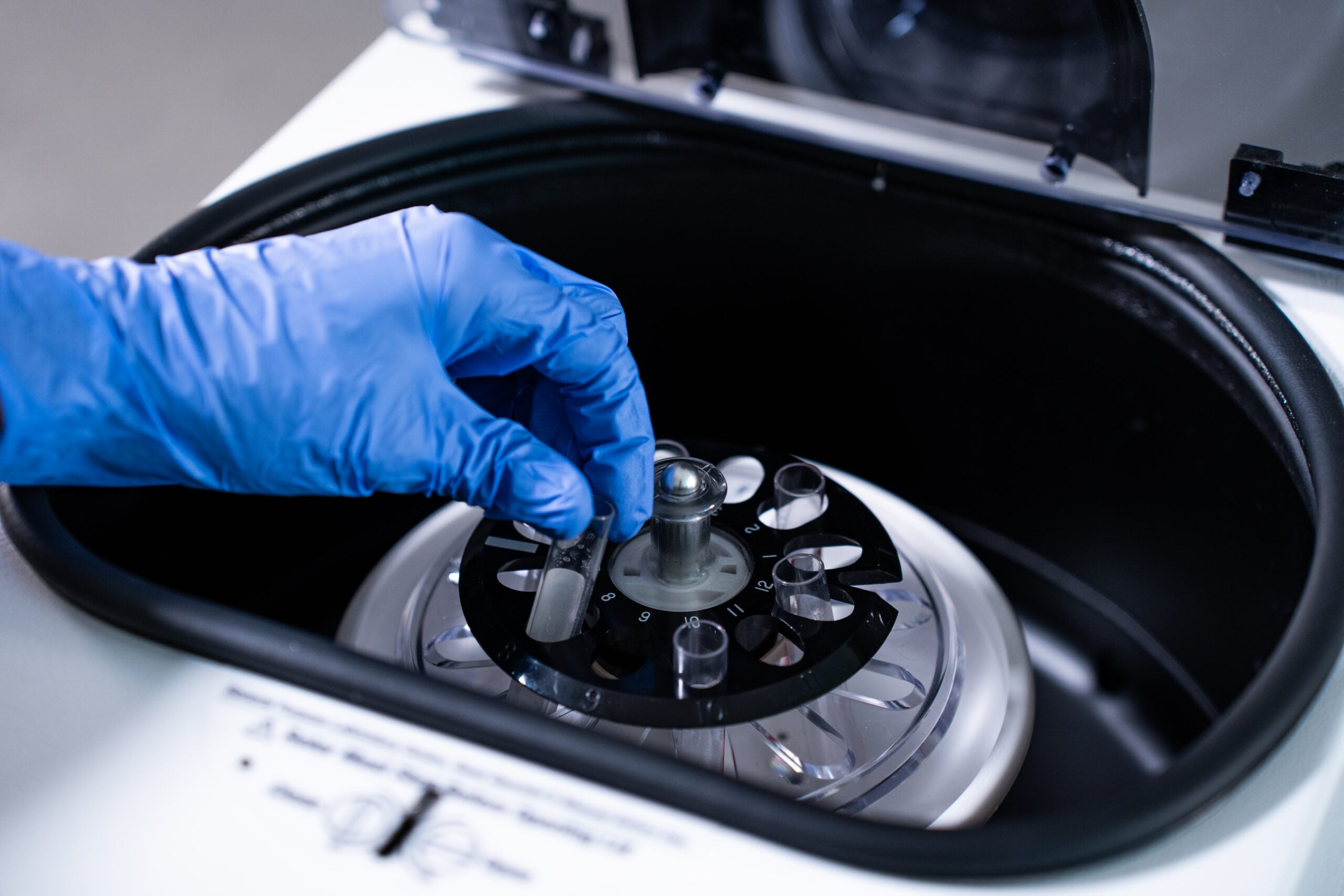
Some serological centrifuges like Drucker Diagnostics’ SERO 12 also use removable rotor heads that function as multi-tube carriers. Instead of handling individual tubes between each step, technicians can fill a group of tubes, centrifuge them together, and continue moving or processing the group as a unit.
This can be especially useful for manual cell-washing procedures, where the same tubes may go through several cycles of centrifugation, decanting, saline addition, and resuspension. A removable rotor helps keep those tubes together throughout the process.
Blood Banking Centrifuge Requirements
Choosing a blood bank centrifuge is about more than maximum speed or tube capacity.
The centrifuge should support the conditions specified by the reagent manufacturer and the laboratory’s validated procedure. Procedures should define the appropriate centrifugation conditions along with other factors such as sample preparation, incubation, and timing.¹
Equipment used for blood compatibility testing must also be maintained, standardized, and calibrated according to applicable requirements and the laboratory’s standard operating procedures. Federal regulations specifically address the maintenance and scheduled observation, standardization, and calibration of equipment used in blood collection, processing, compatibility testing, storage, and distribution.⁵
AABB’s Standards for Blood Banks and Transfusion Services provide additional requirements for blood banks and transfusion services, including quality-system requirements and technical requirements for accredited facilities.⁶
When evaluating a blood bank centrifuge, consider:
- Validated procedures: The centrifuge should support the centrifugation conditions required by the laboratory’s procedures and reagent instructions.
- RCF and time: These are the parameters that define the centrifugation conditions for a procedure, rather than RPM alone.
- Rotor design: A dedicated serology rotor should accommodate the tubes used for testing and support the laboratory’s workflow.
- Capacity: The centrifuge should accommodate the number and type of tubes routinely processed.
- Maintenance and calibration: The equipment should fit into the laboratory’s established maintenance, calibration, and documentation procedures.
Speeds and Spin Times
There is no single speed or spin time that applies to every blood bank procedure. The appropriate centrifugation conditions depend on the reagent, test method, centrifuge, and laboratory procedure.
Most importantly, centrifugation conditions should be defined by RCF and spin time rather than RPM alone. Rotor radius affects the RCF produced at a given RPM, so the same RPM setting can produce different forces on different centrifuges.¹
Reagent instructions illustrate why these matters. DIAGAST’s ABO grouping reagents specify centrifugation at 1,000 RCF for 15 seconds, while allowing a time and speed appropriate to the calibrated centrifuge.² Immucor’s Panoscreen instructions suggest 900–1,000 xg for 15–30 seconds, with the appropriate conditions producing strong reactions while still allowing easy resuspension of antigen-negative red blood cells.³ ORTHO Sera Anti-e specifies 900–1,000 xg for 10 seconds, or conditions appropriate for the centrifuge that produce the desired reaction and allow easy resuspension.⁴
Both under- and over-centrifugation can affect serological testing. Excessive centrifugation can cause unagglutinated cells to pack too tightly and appear agglutinated, while insufficient centrifugation can result in red-cell loss during washing.¹
Manual Cell Washing in Serological Testing
Some antiglobulin procedures require red blood cells to be washed repeatedly with saline before the addition of antiglobulin reagent. Each wash involves centrifuging the tubes, completely decanting the supernatant, adding saline, and resuspending the cells.³
The process needs to be performed carefully. Inadequate washing can leave serum or plasma behind and interfere with the antiglobulin reagent, potentially producing a false-negative result. Insufficient centrifugation can also result in the loss of red cells, while prolonged centrifugation or delays between washing steps can affect the test.¹
Recent testing of positive IgG DAT samples examined delays after red blood cell suspension preparation and after the final wash was decanted, before anti-IgG was added. The authors found that most samples tolerated the delays, but the weakest positive reactions were more susceptible to weakening; the authors therefore recommended minimizing interruptions during DAT procedures.7
A removable serology rotor supports this workflow by keeping tubes together through repeated centrifugation and decanting steps, rather than requiring individual tubes to be handled at each stage.
Replacing the BD Sero-Fuge™
The BD Sero-Fuge has long been the world’s most popular blood banking centrifuge, but the model is now discontinued. Drucker Diagnostics’ SERO 12 offers a direct replacement for labs looking to maintain their existing serology workflows.
The SERO 12 uses the exact same rotors and accessories as the Sero-Fuge.⁸ Designed for blood grouping and typing, crossmatching, and cell-washing procedures, it reaches speeds up to 3,600 RPM and 1,040 xg and offers 10 programmable cycles through its digital display.⁹
Learn more about replacing the BD Sero-Fuge with the SERO 12.
Choosing the Right Blood Bank Centrifuge
A blood bank centrifuge is designed around the unique requirements of serological testing, not general specimen separation. The rotor, centrifugation parameters, tube capacity, and workflows all play a role in how the equipment supports blood grouping, typing, crossmatching, and cell washing.
When evaluating a serological centrifuge, start with the procedures your lab performs regularly, and the conditions specified by the reagent manufacturers. From there, consider the rotor design, capacity, RCF range, spin-time control, and maintenance requirements needed to support those procedures.
Ready to find the right centrifuge for your lab? Contact Drucker Diagnostics at [email protected] or +1-866-265-1486 to learn more about our blood banking centrifuges.
References
- Raman L, Armstrong B, Smart E. “Principles of laboratory techniques.” ISBT Science Series. 2020;15(S1):81–111. ISBT Science Series – Principles of Laboratory Techniques
- Anti-A (ABO1), Anti-B (ABO2), Anti-A,B (ABO3) Instructions for Use. U.S. FDA. FDA – DIAGAST ABO Reagent Instructions for Use
- Panoscreen I and II Reagent Red Blood Cells Instructions for Use. U.S. FDA. FDA – Panoscreen Instructions for Use
- ORTHO Clinical Diagnostics. ORTHO Sera Anti-E Blood Grouping Reagent Instructions for Use.S. FDA. FDA – ORTHO Sera Anti-e Instructions for Use
- S. Food and Drug Administration. 21 CFR § 606.60 – Equipment. eCFR § 606.60
- Standards for Blood Banks and Transfusion Services, 35th ed. 2026. AABB Standards for Blood Banks and Transfusion Services
- Stock AJ, Hamilton JR, Puca KE, Leon NM, Johnson ST. “How slow can you be when performing a direct antiglobulin test?” 2026;42(2):35–41. PubMed – How slow can you be when performing a direct antiglobulin test?
- Drucker Diagnostics. SERO 12 Blood Banking Centrifuge. SERO 12 Blood Banking Centrifuge
- Drucker Diagnostics. SERO 12 Blood Banking Centrifuge Datasheet, Form No. 1066 Rev. D.