

How to Calculate G-Force (RCF): Centrifuge Formula & Calculator Guide
Published October 15, 2025Accurate centrifugation starts with setting the correct g-force. This value — also called relative centrifugal force, or RCF — determines how much force is applied to your samples during spinning and directly affects separation quality, sample integrity, and downstream testing accuracy.
Most tube manufacturers specify a required g-force in their instructions for use (IFU), so always follow those guidelines. If your centrifuge doesn’t display g-force directly, you can calculate it from your rotor radius and RPM. This guide walks through the formulas, explains the relationship between RPM and g-force, and includes a reference table for quick conversions. If you’re evaluating new equipment, note that many centrifuges with preset RCF programming eliminate the need for manual calculation by letting you enter g-force directly.
TLDR
- G-force (RCF) is the centrifugal acceleration applied to a sample, expressed as a multiple of Earth’s gravity. 1,000 ×g means 1,000 times normal gravity.
- Calculate RCF from rotor radius and RPM: RCF = 0.00001118 × radius (cm) × RPM².
- RCF and RPM are not interchangeable — the same RPM produces different RCF on rotors of different radii. Protocols specify RCF for this reason.
What is g-force in centrifugation?
G-force, or relative centrifugal force (RCF), measures the centrifugal acceleration applied to samples during spinning — expressed as a multiple of Earth’s gravity. When a centrifuge runs, it pushes samples outward from the center of rotation, separating components by density: cells from plasma, sediment from supernatant, and so on.
A setting of 1,000 ×g means samples experience a force 1,000 times stronger than normal gravity. Getting this right matters because g-force directly controls separation efficiency, processing time, and whether delicate samples survive the spin intact.
Is RCF the same as g-force?
Yes — RCF (relative centrifugal force) and g-force refer to the same measurement in centrifugation. Both express centrifugal acceleration as a multiple of Earth’s gravity, and the terms are used interchangeably in clinical lab settings.
What factors determine g-force in a centrifuge?
The force exerted on a sample in a centrifuge depends on two main factors:
-
the rotation speed of the centrifuge (RPM), and
-
the radius of the rotor.
Together, these determine the relative centrifugal force (RCF), commonly referred to as g-force. Different rotor geometries (fixed-angle, swing-out, vertical) also affect how the radius is measured and what RCF is actually applied at each position in the tube. For a breakdown, see our guide on rotor types and selection.
G-force calculator: converting RPM to g-force
If you know your centrifuge’s RPM and rotor radius, use these formulas to calculate g-force (RCF):
-
Using centimeters:
RCF (g-force) = 0.00001118 × Rotor Radius × (RPM)² -
Using inches:
RCF (g-force) = 0.0000284 × Rotor Radius × (RPM)²
These calculations allow you to verify that your centrifuge is applying the correct amount of force to meet the requirements of your test or tube manufacturer.
Converting g-force to RPM
When you know the required g-force but need to find the correct RPM setting:
-
Using centimeters:
RPM = √(g-force / (0.00001118 × Rotor Radius)) -
Using inches:
RPM = √(g-force / (0.0000284 × Rotor Radius))
How do I measure the rotor radius?
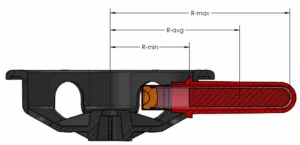
The rotor radius is the distance from the center of rotation to the end of the tube. This measurement can be taken in either centimeters or inches. You can measure the radius at different points:
-
Minimum radius: at the top of the specimen
-
Average radius: at the middle of the specimen
-
Maximum radius: at the bottom of the specimen
Drucker Diagnostics recommends using the maximum radius, as it’s the industry standard for calculating g-force. Most clinical rotors, like the one on Drucker’s HORIZON 642E clinical centrifuge, publish this value in the product specifications.
RPM vs. g-force: why they’re not interchangeable
RPM (revolutions per minute) tells you how fast the rotor is spinning. G-force tells you how much force your samples are actually experiencing. The two are related, but not equivalent — the same RPM produces different g-force depending on rotor radius.
A larger rotor radius generates more g-force at any given RPM. For example:
-
A rotor with a 15 cm radius spinning at 3,500 RPM generates about 2,058 ×g.
-
A rotor with a 5 cm radius spinning at the same speed generates about 686 ×g.
This is why protocols specify g-force rather than RPM — it’s the only way to ensure consistent results across different centrifuges. Understanding RCF is one piece of operating a centrifuge correctly. For the full workflow — loading, balancing, spinning, and maintenance — see our complete centrifuge operation guide.
Can I use a nomograph instead of formulas?
Yes. If you prefer a visual method, a nomograph can help you quickly determine either g-force or RPM. Once you know the required g-force for your protocol, measure the rotor radius and refer to a nomograph to find the appropriate RPM setting—or use the equations provided above.
What are the best practices for accurate centrifugation?
Getting RCF right is the starting point, but it only holds if the rest of the workflow is sound. Three things protect sample quality and repeatability:”
- Calibrate regularly. Operating speed should agree with tachometer measurement within ±100 RPM. See our centrifuge calibration check guide for the procedure.
- Balance samples by mass, not volume. Opposing tubes should match within 0.5 grams. See how to balance tubes correctly for the full procedure.
- Use equipment with RCF programming. Manual RPM calculation works, but eliminates a common source of error when the centrifuge accepts g-force directly. Drucker’s DASH STAT centrifuges support this natively.
If your centrifuge displays both RPM and g-force, setting it correctly is straightforward. If not, use the calculations above to determine the correct RPM to achieve the desired force.
Frequently Asked Questions
Is RCF the same as g?
Yes. RCF (relative centrifugal force) and g-force refer to the same thing: centrifugal acceleration expressed as a multiple of Earth’s gravity. A protocol calling for 1,500 ×g applies the same force as a protocol calling for 1,500 RCF. The notation varies by source — some use ×g, some use RCF, some write “g-force” — but the value is identical.
What RPM do I need for 1,000 ×g?
The answer depends on rotor radius. At a 10 cm radius, about 2,990 RPM produces 1,000 ×g. At a 15 cm radius, about 2,440 RPM does the same. At 5 cm, you need about 4,230 RPM. Use the formula RPM = √(g-force / (0.00001118 × radius in cm)) to calculate the exact value for your rotor. This is why protocols specify RCF: the same g-force takes different RPM settings on different equipment.
How accurate is a centrifuge g-force calculator?
A calculator’s math is exact — but the output is only as accurate as the rotor radius you enter and the speed your centrifuge actually runs at. Two things cause real-world drift: using a nominal rotor radius instead of the measured maximum radius, and running on an uncalibrated centrifuge where displayed RPM differs from actual RPM. Drucker recommends checking calibration every two years, with tolerance of ±100 RPM at speed. For the procedure, see our centrifuge calibration check guide.
Setting your centrifuge accurately helps protect sample quality, ensures test reliability, and supports consistent, repeatable results every time you spin. Browse Drucker centrifuge models or contact our team for help selecting a system matched to your protocol requirements.