
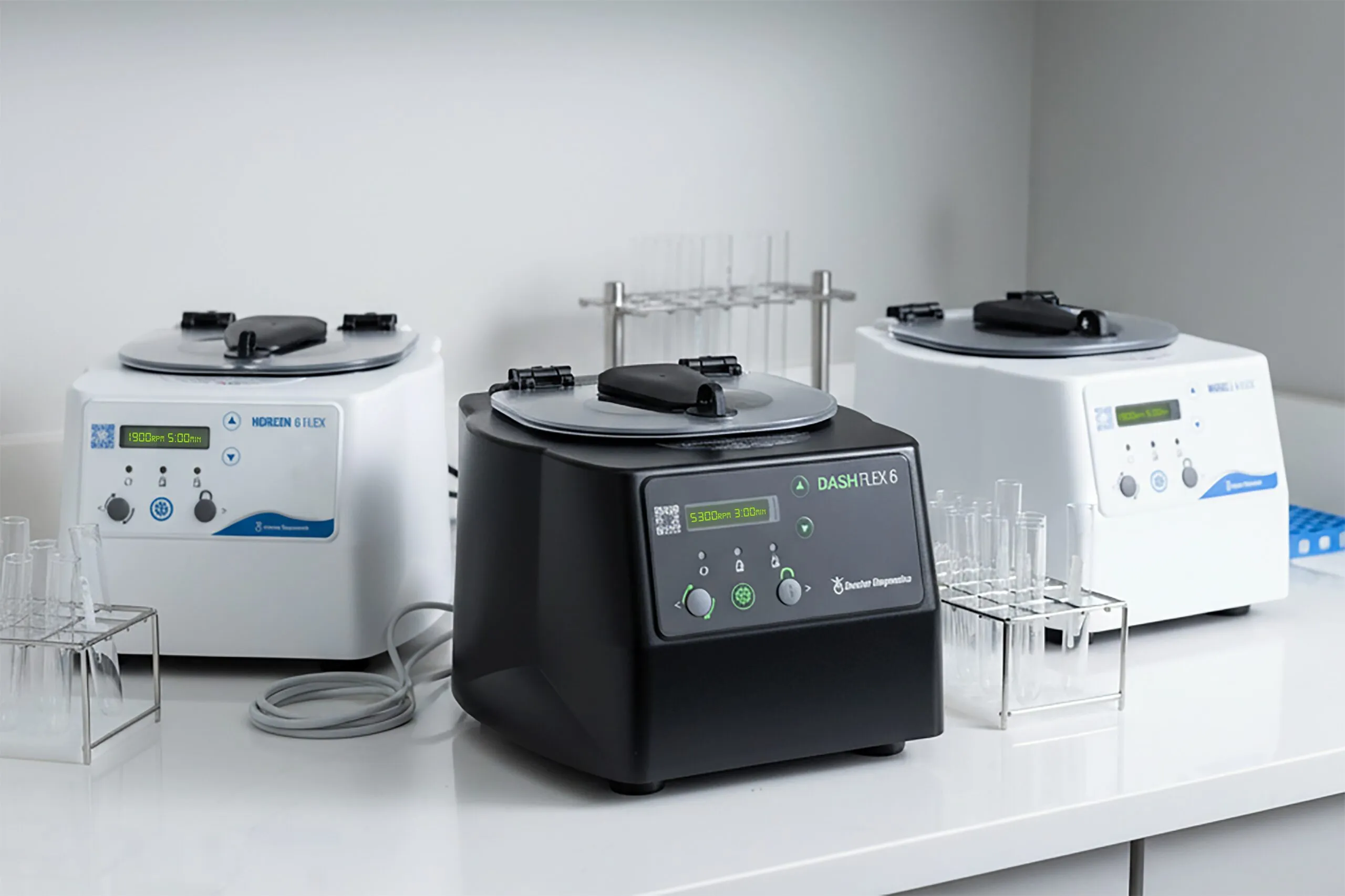
Types of Laboratory Centrifuges Explained
Published February 12, 2026Lab managers and technicians often face confusion when selecting centrifuges because manufacturers classify them differently—some by speed, others by size, and still others by application. Understanding these classification systems helps you choose the right centrifuge for your specific lab workflow.
TLDR:
- Laboratory centrifuges are classified by speed (low-speed up to 5,000 RPM, high-speed 15,000-30,000 RPM, ultracentrifuge exceeding 100,000 RPM), size (microcentrifuge, benchtop, floor-standing), and specialized features (refrigerated, clinical, continuous flow)
- Speed determines what you can separate—measured in relative centrifugal force (RCF or ×g), not just RPM—with low-speed handling cells at 3,000-7,000 ×g, high-speed processing proteins at 15,000-110,000 ×g, and ultracentrifuges isolating viruses at up to 1,000,000 ×g
- Size affects lab footprint and capacity, while specialized features like refrigeration (-20°C to +40°C) protect temperature-sensitive samples during processing
Quick Classification Guide
What are the main types of laboratory centrifuges?
Laboratory centrifuges fall into three main classification systems: speed-based (low-speed, high-speed, ultracentrifuge), size-based (microcentrifuge, benchtop, floor-standing), and application-based (clinical, refrigerated, continuous flow). Most centrifuges fit multiple categories—for example, a refrigerated benchtop high-speed centrifuge.
How Laboratory Centrifuges Work
Laboratory centrifuges separate sample components through centrifugal force—the outward force created when objects spin around a central axis. This technology dates to 1864 when Antonin Prandtl proposed using centrifugal force to separate cream from milk.
Samples are loaded into balanced tubes and placed in a rotor. The motor spins the rotor to programmed speed, generating centrifugal force that pushes denser particles outward to the tube bottom or sides while lighter particles remain near the center. After the programmed time, the rotor decelerates and tubes are removed for sample collection.
Without centrifugation, many separations would take hours or days under normal gravity. Centrifuges reduce this to minutes by applying forces thousands of times stronger than gravity.
Understanding RCF vs RPM
Centrifuge protocols specify RCF (relative centrifugal force) rather than RPM because RCF measures the actual force applied to samples. The same RPM creates different forces depending on rotor size—a critical distinction when following protocols or comparing centrifuges.
RCF is expressed in units of ×g (times gravity). Common RCF ranges include:
- Low-speed applications: 300-7,000 ×g for cell pelleting, blood separation, routine clinical work
- High-speed applications: 15,000-110,000 ×g for protein precipitation, DNA/RNA extraction, subcellular fractionation
- Ultracentrifuge applications: 100,000-1,000,000 ×g for virus purification, ribosome isolation, density gradient separations
Most modern centrifuges display both RPM and RCF simultaneously.
Classification by Speed and Application
Low-Speed Centrifuges
Low-speed centrifuges operate at 300-5,000 RPM, generating forces of 600-7,000 ×g. These centrifuges handle routine separations of large particles without lysing cells or denaturing proteins.
Clinical diagnostic laboratories use low-speed centrifuges for serum separation, urine sediment analysis, and routine blood processing. The lower speeds minimize hemolysis while providing adequate blood component separation. Most models accommodate larger tube volumes (15-500 mL) and use swinging-bucket rotors that create clean interfaces between separated phases.
Typical specifications:
- Speed: 300-5,000 RPM
- RCF: 600-7,000 ×g
- Capacity: 4-28 tubes (15-500 mL)
- Applications: Blood banking, clinical diagnostics, cell washing, initial sample processing
High-Speed Centrifuges
High-speed centrifuges reach 15,000-30,000 RPM, generating forces of 15,000-110,000 ×g. This range handles the majority of molecular biology and biochemistry protocols requiring subcellular component separation.
These centrifuges offer sufficient force for protein precipitation, bacterial harvesting, and nucleic acid extraction without the expense of ultracentrifuge operation. Temperature control is nearly universal in this category since higher speeds generate more frictional heat.
Most high-speed centrifuges accept both fixed-angle rotors (for efficient pelleting) and swinging-bucket rotors (for density gradients), letting a single centrifuge handle diverse protocols.
Typical specifications:
- Speed: 15,000-30,000 RPM
- RCF: 15,000-110,000 ×g
- Capacity: 4-6 bottles (50-1,000 mL) or 12-24 tubes (15-50 mL)
- Applications: Subcellular fractionation, virus concentration, protein purification, bacterial cell harvesting, DNA/RNA isolation
Ultracentrifuges
Ultracentrifuges achieve forces exceeding 100,000 ×g and up to 1,000,000 ×g, enabling separation of viruses, protein complexes, ribosomes, and other macromolecules. These specialized instruments require vacuum chambers to prevent rotor friction at extremely high speeds and always include refrigeration.
Two types exist: preparative ultracentrifuges for sample processing (typical maximum 802,000 ×g, volumes to 250 mL) and analytical ultracentrifuges with optical detection systems for real-time sedimentation monitoring.
Ultracentrifuge applications earned Theodor Svedberg the 1926 Nobel Prize in Chemistry for proving proteins are macromolecules. The 1958 Meselson-Stahl experiment demonstrating semiconservative DNA replication relied on cesium chloride density gradient ultracentrifugation.
Typical specifications:
- Speed: Exceeding 100,000 RPM
- RCF: 100,000-1,000,000 ×g
- Capacity: 0.2-250 mL depending on rotor
- Applications: Virus purification, lipoprotein separation, ribosome isolation, exosome purification, nanoparticle characterization, density gradient separations
Only research laboratories, vaccine manufacturers, and specialized reference labs typically require ultracentrifuges due to their high cost (often exceeding $100,000), specialized maintenance requirements, and limited applications outside advanced molecular biology.
Classification by Size and Form Factor
Microcentrifuges
Microcentrifuges accommodate microcentrifuge tubes from 0.2 mL to 2.0 mL in compact units often smaller than a shoebox. Their small footprint makes them essential for molecular biology benches where multiple users need quick access without occupying valuable workspace.
First introduced as the Eppendorf Model 3200 in 1962, microcentrifuges transformed molecular biology by enabling quick spins for routine DNA, RNA, and protein work. Modern models reach 21,000 ×g and include both refrigerated and ambient temperature versions.
Typical specifications:
- Speed: 5,000-21,000 RPM
- RCF: 2,000-21,000 ×g
- Capacity: 6-24 tubes (0.2-2.0 mL)
- Temperature: Ambient or refrigerated (-10°C to +40°C in refrigerated models)
- Applications: PCR sample prep, nucleic acid precipitation, quick spins, microvolume protein work, miniprep kits
Benchtop Centrifuges
Benchtop centrifuges represent the most versatile category, available in configurations from low-speed clinical models (1,200-3,000 ×g) to refrigerated high-speed research units (up to 25,000 ×g). These centrifuges fit on lab benches while handling tube sizes from 0.2 mL microcentrifuge tubes to 750 mL bottles.
The key advantage is rotor interchangeability. A single benchtop centrifuge can accommodate swinging-bucket rotors for blood separation, fixed-angle rotors for pelleting, microplate rotors for high-throughput screening, and specialized rotors for specific tube sizes. This versatility makes benchtop centrifuges the workhorse of most laboratories.
Typical specifications:
- Speed: 300-15,000 RPM
- RCF: 300-25,000 ×g
- Capacity: Varies by rotor—commonly 4-6 bottles (250-750 mL) or 12-24 tubes (15-50 mL)
- Temperature: Ambient or refrigerated (-20°C to +40°C)
- Applications: Tissue culture, blood processing, cell culture, protein work, DNA/RNA extraction, clinical diagnostics, general separations
Floor-Standing Centrifuges
Floor-standing centrifuges offer maximum capacity and speed in larger instruments requiring dedicated floor space and often reinforced flooring to handle vibration. These centrifuges process high volumes essential for blood banks, pharmaceutical manufacturing, and large-scale research.
Capacities reach 8 liters or more with rotors holding multiple 2,000 mL bottles. Forces up to 100,000 ×g enable applications overlapping with ultracentrifuges but at lower cost and with easier maintenance.
Typical specifications:
- Speed: 1,000-30,000 RPM
- RCF: 2,000-100,000 ×g
- Capacity: 4-8 bottles (up to 2,000 mL each)
- Temperature: Usually refrigerated (-20°C to +40°C)
- Applications: Large-scale cell harvesting, vaccine production, bioprocessing, blood component separation, high-volume sample processing
Specialized Centrifuge Types
Refrigerated Centrifuges
Refrigerated centrifuges maintain sample temperatures from -20°C to +40°C, counteracting frictional heat generated during high-speed operation. Temperature control is essential when processing heat-sensitive biological materials that denature or degrade at elevated temperatures.
Most molecular biology and clinical chemistry applications require refrigeration. Enzymes lose activity, antibodies aggregate, RNA degrades, and proteins denature when exposed to heat during extended centrifugation. The temperature control adds cost—refrigerated models typically cost 50-100% more than ambient temperature equivalents—but preserves sample integrity.
Common refrigerated applications:
- DNA/RNA extraction and purification (4°C)
- Protein purification and precipitation (4°C)
- Antibody isolation (4°C)
- Clinical chemistry blood processing (4-8°C)
- Live cell processing (4°C)
- Enzyme assays (4°C)
Clinical Centrifuges
Clinical centrifuges are designed specifically for medical diagnostics and blood processing in hospital laboratories, reference labs, and clinical testing facilities. These centrifuges must meet CLIA (Clinical Laboratory Improvement Amendments) requirements in U.S. clinical laboratories.
Key features include sealed rotors or biocontainment lids preventing aerosol release, automatic lid locks preventing opening during operation, and imbalance detection stopping unsafe runs. Preset programs for standard tests (hematocrit, serum separation, plasma preparation) simplify operation for clinical laboratory staff.
Clinical centrifuges typically operate at lower speeds (1,200-3,000 ×g) optimized for blood component separation without causing hemolysis.
Typical specifications:
- Speed: 1,000-4,000 RPM
- RCF: 1,200-3,000 ×g
- Capacity: 12-28 blood collection tubes
- Applications: Serum separation, plasma preparation, hematocrit measurement, urine analysis
Hematocrit Centrifuges
Hematocrit centrifuges are specialized units designed exclusively for spinning capillary tubes filled with blood to measure red blood cell volume percentage. These compact centrifuges spin at 11,000-12,000 RPM for 3-5 minutes according to NIH clinical guidelines.
The microhematocrit method developed by Maxwell Wintrobe in the 1930s revolutionized hematocrit testing by reducing sample volume requirements. Modern hematocrit centrifuges include built-in readers for measuring the packed cell volume after centrifugation.
Clinical diagnostic laboratories use hematocrit measurements to diagnose anemia, dehydration, and polycythemia. The quick processing time (typically 60-90 seconds) makes hematocrit centrifuges essential for STAT labs and point-of-care testing.
Continuous Flow Centrifuges
Continuous flow centrifuges process large volumes by continuously feeding sample through the rotor while collecting separated components, eliminating the batch loading/unloading cycle. This design suits industrial and large-scale laboratory applications processing hundreds of liters.
Applications include large-scale cell culture harvesting in biotech facilities, pharmaceutical manufacturing, and industrial biotechnology. These specialized centrifuges are uncommon in standard research laboratories but essential in production-scale bioprocessing facilities.
Vacuum Centrifuges (Concentrators)
Vacuum centrifuges combine centrifugation with vacuum and optional heat to concentrate samples by evaporating solvent. Unlike standard separatory centrifuges, concentrators focus on sample preparation rather than component separation.
The vacuum prevents sample bumping while centrifugal force keeps samples in tubes during evaporation. Researchers use vacuum centrifuges to concentrate nucleic acids after precipitation, dry down HPLC fractions, and prepare samples for mass spectrometry.
Laboratory Applications by Centrifuge Type
| Laboratory Setting | Centrifuge Type | Typical Application | RCF Range |
| Hospital/Clinical Labs | Clinical Centrifuge | Serum/plasma separation | 1,200-3,000 xg |
| Hematocrit Centrifuge | Measuring blood cell volume | 1,850 xg-13,700 xg | |
| Benchtop Centrifuge | Routine diagnostic separations | 300-6,000 xg | |
| Reference Labs | High-Speed Centrifuge | Molecular diagnostics | 15,000-50,000 xg |
| Floor-Standing | High-volume processing | 2,000-25,000 xg | |
| Research Labs | Microcentrifuge | DNA/RNA work, PCR prep | 5,000-21,000 xg |
| Benchtop Centrifuge | General sample preparation | 300-25,000 xg | |
| High-Speed Centrifuge | Subcellular fractionation | 15,000-110,000 xg | |
| Ultracentrifuge | Virus purification, macromolecule analysis | 100,000-1,000,000 xg | |
| Biotechnology | High-Speed Centrifuge | Protein purification, cell harvesting | 15,000-110,000 xg |
| Floor-Standing | Large-scale bioprocessing | 5,000-50,000 xg | |
| Blood Banks | Floor-Standing | Component separation | 2,000-5,000 xg |
| Clinical Centrifuge | Routine blood processing | 1,200-3,000 xg | |
| Pharmaceutical R&D | High-Speed Centrifuge | Drug development | 10,000-50,000 ×g |
| Ultracentrifuge | Analytical testing | 100,000-1,000,000 ×g |
Choosing the Right Laboratory Centrifuge Type
Match centrifuge type to your laboratory’s primary application requirements:
For molecular biology labs: Microcentrifuges handle daily tasks for 0.2-2 mL volumes. Add a benchtop high-speed centrifuge for larger volumes and plasmid preparations.
For clinical diagnostic laboratories: Benchtop clinical centrifuges with preset programs cover routine blood work. Hematocrit centrifuges provide quick CBC measurements. Consider refrigeration for chemistry panels.
For cell culture work: Benchtop centrifuges with swinging-bucket rotor capability provide versatility. Refrigeration protects cell viability during processing.
For protein research: High-speed refrigerated centrifuges handle most protocols. Ultracentrifuge access enables specialized protein complex work.
For high-volume processing: Floor-standing refrigerated centrifuges handle large sample loads efficiently in blood banks, reference labs, and production facilities.
The key decision points are maximum RCF requirements (based on protocols), typical sample volumes (determines size category), and temperature sensitivity (determines refrigeration needs). Many laboratories benefit from multiple centrifuge types—a microcentrifuge for routine molecular work paired with a benchtop centrifuge for larger volumes covers most research and clinical diagnostic needs.
Need help selecting a centrifuge for your laboratory? Drucker Diagnostics manufactures ready-to-use centrifuges designed to eliminate rotor and adapter confusion. Our DASH, HORIZON, and 600 Series centrifuges ship ready for immediate use with matched rotors and carriers for clinical diagnostic laboratories. Contact us to discuss your lab’s centrifuge needs.