
When to Replace Your StatSpin: Clinical Lab Manager’s Equipment Guide
Published January 13, 2026Your StatSpin centrifuge has served you well, but laboratory equipment doesn’t last forever. Whether you’re dealing with aging hardware, parts availability concerns, or exploring better options, knowing when and how to upgrade matters.
TLDR:
- StatSpin is legacy equipment with declining parts availability
- DASH offers equivalent performance with 2-year warranty vs. standard 1-year
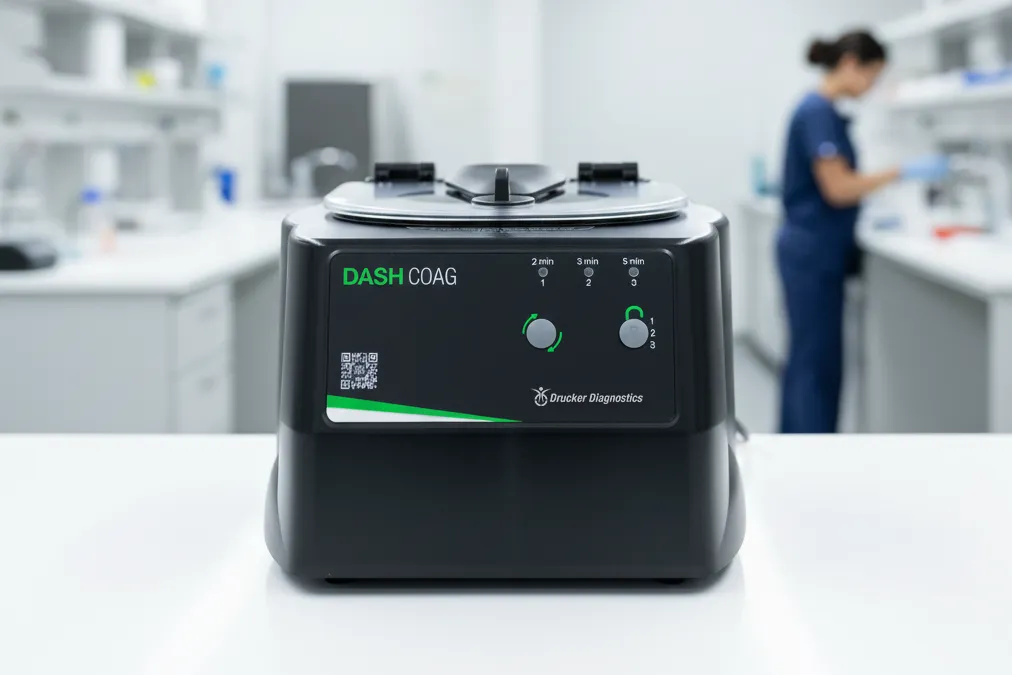
- Capacity advantage: DASH Coag processes 12 tubes vs. Express 3’s 8 tubes (50% more throughput)
- All models include US-based support and optional facility branding
- 30-day free evaluation, no payment required
When should you replace your StatSpin?
Most centrifuges deliver 7-10 years of reliable service. Consider replacement when:
Repair costs exceed 40% of replacement value. At 8+ years of continuous use, maintenance costs typically accelerate while equipment reliability declines.
Parts availability becomes unpredictable. Extended downtime waiting for components directly impacts turnaround times.
Performance degrades. Older units struggle maintaining consistent RCF values and cycle speeds, which affects sample quality and creating workflow bottlenecks in STAT environments.
You’re standardizing across facilities. Multiple locations benefit from unified equipment, simplified training, and consistent sample processing protocols.
Which DASH model fits your lab?
Hospital STAT Labs
Small-volume STAT (chemistry, blood bank): DASH Apex 4 matches Express 2’s performance (4 tubes, 30 sec/2 min/3 min at 4440 xg) in a compact 7x7x7-inch footprint. Identical presets mean zero workflow disruption.
Coagulation testing: The DASH Coag’s 12-tube capacity vs. Express 3’s 8 tubes eliminates 4 cycles per 96 samples—saving 8-12 minutes of technician time per shift. That’s 32-48 hours annually of recovered productivity.
General hematology/chemistry: DASH models provide horizontal centrifugation with 10 preset options vs. Express 4’s 3 settings. One DASH Flex 12 handles work requiring two Express 4 units in high-volume departments.
Reference Laboratories
High-volume processing (200+ samples daily) benefits from multiple DASH Coag units. Three DASH Coag centrifuges process 36 tubes per cycle—volume requiring 5 StatSpin Express 3 units. Fewer units reduce total cost of ownership and simplify maintenance.
Multi-site operations: Standardizing on DASH with facility branding simplifies cross-site training and ensures consistent sample handling. Custom logos and colors reinforce professional image while tracking inventory.
Physician Office Labs & Urgent Care
Simplicity and space: DASH Apex 4’s 2-button, 3-preset interface requires minimal training—critical for settings with high staff turnover. Cube design (7x7x7 inches) maximizes tight counter space while delivering hospital-grade separation.
Budget focus: Better price-to-performance ratio than StatSpin with double warranty coverage (2 years vs. 1 year). Extended warranty matters more in lower-volume settings with less experienced staff.
Why capacity matters
Tube capacity directly impacts efficiency, but optimal capacity varies by testing patterns:
Low-volume (20-40 samples daily): DASH Apex 4’s 4-tube capacity balances throughput with minimal footprint.
Medium-volume (60-120 samples daily): DASH Coag’s 12 tubes vs. Express 3’s 8 tubes means 7 cycles instead of 10 at 80 samples—3 fewer loading/unloading interruptions per shift.
High-volume (200+ samples daily): Two DASH 12 units (24 total tubes) provide better flexibility than one large-capacity unit. If one needs service, you maintain 50% capacity. Run different protocols simultaneously—chemistry in one, coagulation in the other.
Redundancy matters most in 24/7 operations where downtime directly impacts patient care.
Support advantages that matter
Extended warranty: 2-year coverage including calibration guarantee ensures consistent RCF values over time—most issues appear in year two as components wear from continuous use.
US-based support: Reach Central Pennsylvania technicians in your time zone who understand US laboratory workflows. Critical during urgent situations when downtime impacts patient care.
Parts availability: Active production means common wear items ship within 24-48 hours. StatSpin parts face increasingly extended wait times as equipment becomes legacy.
Customization: Facility branding serves practical purposes—track inventory across locations, distinguish client areas in shared lab spaces, reinforce professional image.
Making the switch
30-day evaluation: Test DASH centrifuges in your lab without obligation. Run parallel testing with your StatSpin—process identical samples in both units to validate performance before purchase.
Minimal training: 15-20 minutes per staff member covers preset selection, tube balancing, and basic troubleshooting. Simple interfaces mean 1-2 supervised shifts build full confidence.
No protocol changes: DASH delivers separation quality equivalent to StatSpin units. Transition requires no method revalidation—eliminating a common barrier to equipment upgrades.
What labs report after switching
Fewer service calls: Extended warranty covers most issues without out-of-pocket expense.
Faster support response: Direct US-based assistance when equipment issues arise.
Measurable workflow improvements: Express 3 to DASH Coag users report 50% capacity increase translates to fewer daily cycles and reduced technician time.
Equivalent performance: No protocol changes required—DASH processes samples identically to previous StatSpin units.
Try a DASH centrifuge free for 30 days. No payment information required. Test with your samples, your workflow, your team—verify performance meets your standards before deciding.
For facilities managing multiple aging StatSpin centrifuges, this evaluation validates equipment before committing to facility-wide replacement.