
Rotor Care 101: How to Extend the Life of Your Centrifuge Rotor
Published July 9, 2025Your centrifuge rotor is one of the most expensive components in your laboratory, with costs ranging from $1,000 to $15,000 depending on the type. Yet most labs replace rotors prematurely—not from wear, but from preventable corrosion and damage caused by poor maintenance habits.
With proper care, a rotor that might fail in 3-5 years can reliably serve your lab for 15-20 years or more. This guide provides actionable steps to maximize your rotor investment, whether you’re maintaining existing equipment or evaluating a new purchase.
How Do I Make My Centrifuge Rotor Last Longer?
Extending rotor life comes down to five essential practices: cleaning after every run to prevent corrosion, proper load balancing to avoid stress damage, weekly inspections to catch problems early, tracking run-hours to know when replacement is needed, and proper storage to prevent deterioration. The good news is that none of these require expensive equipment or specialized training—just consistent attention to simple habits. Most rotors fail prematurely from corrosion and balancing issues, both of which are entirely preventable with basic maintenance that takes just minutes per day.
TLDR: Five Actions That Matter Most
- Clean after every run with mild detergent and warm water—corrosion starts within hours, not days
- Balance loads within 0.5g using opposite positions and tubes of equal weight—unbalanced loads cause 70% of premature failures
- Track run-hours in a logbook to know when derating or replacement is needed—manufacturers specify maximum life in hours, not years
- Store rotors inverted (upside down) in a dry location to prevent water pooling and corrosion
- Inspect weekly for cracks, corrosion (white powder), and wear at critical points like threads and O-rings
Why Does My Centrifuge Rotor Wear Out?
Your rotor faces three primary threats: metal fatigue from spinning forces, corrosion from sample contact, and mechanical wear from temperature changes. A high-speed rotor operating at 15,000 RPM generates forces exceeding 20,000 xg—equivalent to 20,000 times the force of gravity pulling on every molecule of metal. This constant stress causes microscopic changes in the metal’s crystalline structure, gradually weakening it over thousands of runs.
Aluminum rotors are particularly vulnerable to chloride ions found in nearly all biological buffers. PBS, saline, cell culture media, and blood all contain chlorides that aggressively attack aluminum. Temperature cycling between room temperature and refrigeration adds additional stress through expansion and contraction. You can’t eliminate these stresses—they’re inherent to centrifugation—but you can dramatically slow their effects through consistent care.
How to Clean a Centrifuge Rotor (and How Often)
Before Every Run (30 seconds): Run your hand over the rotor surface feeling for roughness or irregularities. Look inside tube cavities for white powdery deposits or discoloration. Check that the rotor spins freely on the drive shaft. This quick inspection catches developing problems before they become serious.
After Every Run (2 minutes): Remove the rotor immediately and clean it—not at the end of the day. Fill your sink with warm water and a few drops of laboratory dish soap. Submerge the rotor and use a soft brush to clean all surfaces, especially tube cavities where samples contact the metal. Rinse thoroughly for at least 30 seconds, ensuring all soap residue is gone.
The Critical Drying Step: Shake out excess water, then use compressed air or lint-free cloths to dry completely. Pay special attention to tube cavities and threads where water pools. Never store a wet rotor—moisture trapped in cavities creates corrosion overnight even if the exterior looks dry.
For biological spills: After soap cleaning, wipe surfaces with 70% ethanol before the final rinse. For chemical spills, check the safety data sheet immediately—some require neutralization or may necessitate rotor replacement.
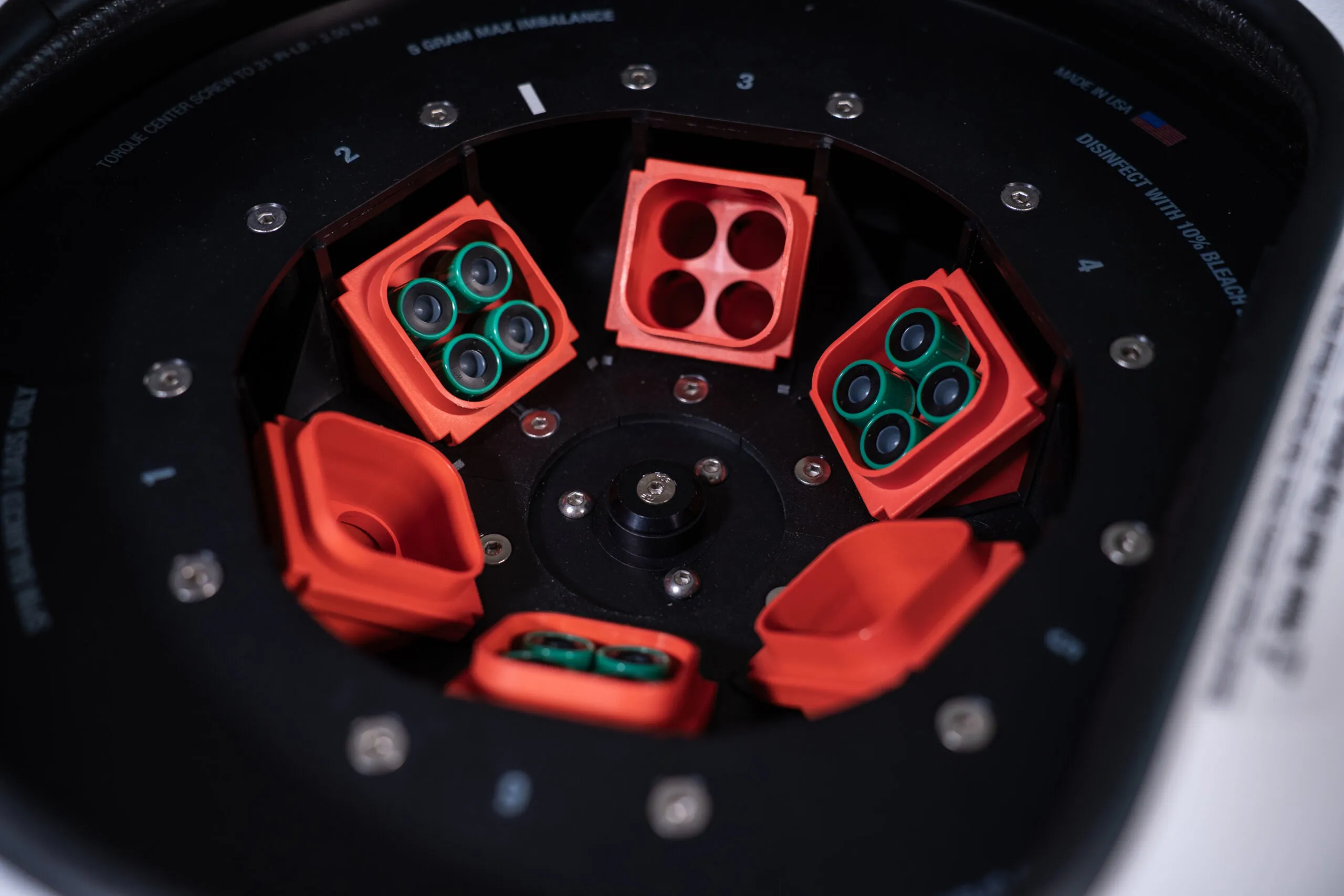
After cleaning swing-out rotors, what should the operator do? After cleaning and rinsing, swing-out rotor buckets should be dried completely, then reassembled with a small amount of manufacturer-approved silicone grease applied to the trunnion pins before reattaching. Do not use general-purpose lubricants — they can degrade seals and attract particulates. Inspect O-rings before reassembly and replace if any flattening, cracking, or cuts are visible.
How Do I Balance My Centrifuge Rotor Correctly?
Improper balancing causes more premature rotor failures than all other factors combined. Purchase a simple laboratory balance that reads to 0.1 gram (costs under $100) and weigh each tube before loading. For high-speed work, balance within 0.1 grams. For routine work under 10,000 RPM, 0.5 gram tolerance is acceptable.
Quick balancing guide:
- 6-position rotor: opposite pairs are 1-4, 2-5, and 3-6
- 8-position rotor: opposite pairs are 1-5, 2-6, 3-7, and 4-8
Mark these pairs with tape on your rotor for quick reference. When working with odd sample numbers, fill a balance tube with water or buffer to match your sample weight—weigh it to verify, don’t guess.
Never mix tube types in the same run. A 15ml plastic conical tube and a glass culture tube might look similar but have vastly different weights. If you must run different tube types, weigh every single tube and match them precisely by weight rather than volume.
Warning signs of imbalance: excessive vibration, grinding or rattling noises, automatic centrifuge stopping, or uneven wear patterns on the rotor. Stop immediately and rebalance if you notice any of these.
What Causes Corrosion on Centrifuge Rotors?
Corrosion appears as white powdery deposits, rough patches, or small pits on rotor surfaces. This occurs when chloride ions break down aluminum’s protective oxide layer. The process accelerates rapidly once started—a small patch creates a rough surface that traps more liquid and accelerates the reaction.
Break the corrosion cycle by:
- Removing chloride-containing samples immediately after runs
- Drying the rotor completely
- Inspecting frequently to catch surface oxidation before it creates pits
If you discover early-stage corrosion (white powder, slight roughness), clean thoroughly with mild detergent, dry completely, and monitor closely. Surface oxidation can be stabilized, but deep pitting requires professional evaluation.
High-risk applications include blood, serum, cell culture media, PBS, and saline. If your lab runs these daily, consider dedicating a rotor to biological samples rather than risking your high-speed research rotor to accelerated corrosion.
What Should I Check During Weekly Rotor Inspections?
Follow a systematic pattern each week to catch problems early:
Exterior surfaces: Look for rough patches, discoloration, or compromised finish—especially near the base where liquids pool.
Tube cavities: Use a flashlight to inspect for white powdery deposits (aluminum oxide), pitting, or rough texture. Run your finger inside each cavity feeling for irregularities. Check threads for cross-threading damage, stripping, or cracks.
Moving parts (swing-bucket rotors): Check bucket pins for wear or looseness. Grab each bucket and test for excessive play. Swing each bucket through its full range of motion, feeling for binding or rough spots.
O-rings and seals: Remove O-rings and examine for cuts, compression set (permanent flattening), or cracking. Replace annually as preventive maintenance—a $5 O-ring replacement prevents leaks that can ruin a $10,000 rotor.
Drive hub: Shine a bright light at a low angle across the drive hub interface. This highlights fine cracks that disappear under direct lighting. Any cracks here require immediate professional evaluation.
How Should I Store My Centrifuge Rotor?
Always store rotors inverted (upside down) so water drains completely. Even a few drops left in a cavity overnight can initiate corrosion. You can make simple storage racks from PVC pipe or wood for under $20.
Remove all buckets and accessories from swing-bucket rotors before storage. Store components separately, also inverted, so air circulates freely. Don’t leave buckets hanging on the rotor—prolonged stress on pivot pins can cause deformation.
Store in a climate-controlled environment. For rotors used infrequently (less than monthly), inspect before storage and again before use. Rotate stored rotors quarterly to prevent O-rings from developing compression set.
For refrigerated rotors: Allow the rotor to reach room temperature before storage. Let it air-dry for 30-60 minutes, wipe away condensation, verify it’s completely dry, then store normally.
How Do I Track Centrifuge Rotor Run-Hours?
Create a simple log at your centrifuge station with five columns: date, run duration (hours), maximum speed (RPM), sample type, and operator initials. Calculate cumulative run-hours monthly and compare to your rotor’s rated maximum life (found in the manufacturer’s manual).
Most rotors specify maximum service life as:
- Fixed-angle rotors: 50,000-100,000 run-hours
- Swinging-bucket rotors: 30,000-60,000 hours
- High-speed/ultracentrifuge rotors: 20,000-40,000 hours
Many rotors require “derating” (reducing maximum speed) as they age. Following derating schedules can double your rotor’s useful life by reducing stress during its later years.
When Should I Replace My Centrifuge Rotor?
Replace immediately if you see:
- Any visible cracks (even hairline fractures)
- Structural deformation
- Deep corrosion pitting you can feel with your fingernail
- Missing critical components
Repair may be possible for:
- Surface corrosion without pitting (stabilize with aggressive cleaning)
- Worn O-rings and seals (replace annually)
- Damaged threads in 1-2 cavities (retire those positions, continue using others)
- Individual damaged buckets on swing-out rotors
When should a centrifuge rotor be retired?
Rotor retirement is the formal removal of a rotor from service — either permanently or at reduced speed. Most manufacturers specify retirement criteria in the rotor manual, typically based on one or more of the following: accumulated run-hours exceeding the rated maximum, evidence of stress corrosion or pitting that cannot be stabilized, cracks at any location, or a documented imbalance event at high speed (which can cause invisible internal stress fractures).
Retirement isn’t always permanent. Many rotors can continue service at reduced maximum RPM — a process called derating — after reaching initial service life thresholds. Check your rotor manual for derating schedules before assuming a rotor is done.
For rotors approaching maximum run-hours or showing concerning wear, schedule professional evaluation. The $200-500 inspection cost prevents premature replacement and ensures safety.
What Cleaning Products Are Safe for Centrifuge Rotors?
Use mild laboratory dish soap (Dawn, Alconox, or pH-neutral detergent) with warm water. This handles 95% of cleaning situations safely and effectively.
Never use:
- Bleach or chlorine-based cleaners (aggressively corrode aluminum)
- Strong acids or bases (strip protective coatings)
- Abrasive cleaners (scratch surfaces, creating corrosion sites)
- Hot water above 140°F (causes thermal stress)
For stubborn biological material, enzymatic cleaners formulated for laboratory use digest proteins without damaging metal. Always rinse thoroughly after using any cleaner.
Do Different Rotor Types Need Different Maintenance?
Fixed-angle rotors: Use bottle brushes to reach deep into angled cavities. Ensure complete drying, as the angle makes drainage difficult. No lubrication required.
Swinging-bucket rotors: Lubricate pivot points every 1-3 months with manufacturer-approved lubricant. Check bucket pins weekly. Clean buckets separately, disassembling completely to reach all surfaces.
Vertical rotors: Inspect seals weekly rather than monthly. Track run-hours meticulously—these often run at very high speeds with shorter service lives.
How Long Should My Centrifuge Rotor Last?
With proper maintenance, most rotors last 10-20 years or longer. Poor maintenance can cut this in half. A rotor that fails after 4 years due to corrosion might have served 15 years with proper cleaning. A rotor destroyed by poor balancing might have run reliably for 20 years.
The difference between premature failure and decades of service comes down to consistent attention to simple practices: clean after every run, balance loads carefully, inspect weekly, document run-hours, and store properly. These habits take minutes but return years of reliable service and thousands in avoided replacement costs.
Your rotor represents a significant investment in your laboratory’s capabilities—treat it with the care it deserves.