
How to Use the DASH 24 Centrifuge: A Guide to Clinical and Research Applications
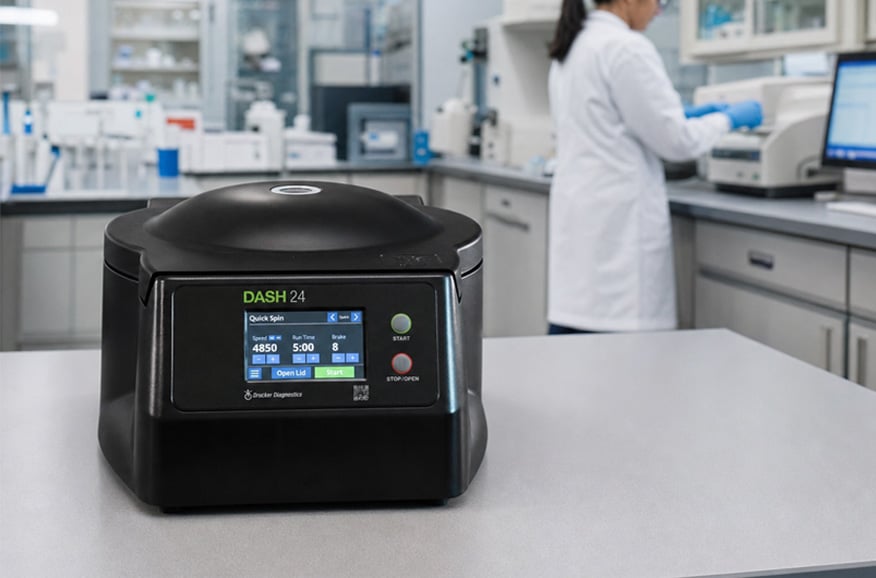
Published May 26, 2026If your lab is using multiple centrifuge models to manage all of your applications, you’re dealing with the operational overhead that comes with it: separate validation records and SOPs, rotor inventories, and competency requirements for every operator on every model. The all-new DASH 24 STAT centrifuge offers a solution. With a 24-tube capacity, maximum speed of 4,850 RPM (4,000 xg), and compatibility with tube sizes from 0.5 mL to 50 mL, it consolidates your workflows while reducing variability.
Here’s how to use the DASH 24 for the most common lab applications, with validated parameters and sample handling considerations for each workflow.
About the DASH 24
The DASH 24 is designed for high-volume STAT labs and research environments that require dependable performance without rotor swaps. The centrifuge holds up to 24 tubes and accommodates standard blood tubes, pediatric blood tubes, microcentrifuge tubes, urine tubes, 15 mL conical tubes, and 50 mL conical tubes. All carriers and adapters are included. The advanced touch-screen interface gives you access to validated preset cycles, and you can create and save custom protocols for specialized applications on the fly using its Quick Spin mode.
Standard Serum Separation
Application: Serum for chemistry panels
Tube Types: Gold/tiger-top SSTs or red tops without gel (5–10 mL)
Protocol: Serum preset — 4,850 RPM (4,000 xg) for 5 minutes, brake setting 5
Serum separation represents the highest-volume centrifugation workflow in most clinical labs. The DASH 24’s Serum preset has been validated against blood tube IFU specifications for high-speed, short-duration centrifugation. Select the preset directly from the touchscreen without manual entry.
Pediatric Serum Separation
For pediatric draws, the Serum preset runs identically. Using the same protocol across both adult and pediatric tube sizes reduces variability across staff members and sample types, which limits opportunities for human error.
Platelet-Poor Plasma (PPP) for Coagulation Studies
Application: PPP for PT/INR and APTT testing
Tube Types: Blue-top 3.2% sodium citrate tubes (2.7 mL)
Protocol: PPP preset — 4,850 RPM (4,000 xg) for 2 minutes, brake setting 1
CLSI guidelines define platelet-poor plasma as a residual platelet count below 10 x 10³/µL. The platelet count threshold exists for mechanistic reasons: platelets contain phospholipids that actively participate in the coagulation cascade. When platelet counts are too high in the plasma fraction, those phospholipids act as endogenous clotting activators and artifactually shorten clotting times, which can mask bleeding disorders or make inadequately anticoagulated patients appear therapeutic.
CLSI’s historical recommendation of 1,500 xg for 15 minutes is well-established, but published studies have consistently shown that accelerated spins can achieve platelet counts below 10 x 10³/µL without clinically significant differences in PT, INR, or APTT results. Validate against your specific tube-analyzer combination before changing any SOPs.
Pipetting Tip: When pipetting plasma off after the spin, stay well clear of the buffy coat interface to avoid pulling up platelets that settled at that boundary. Aim for about 1 cm above the RBC layer.
Platelet-Free Plasma (PFP)
For assays that require platelet-free plasma (defined as below 5 x 10³/µL), such as lupus anticoagulant testing or antiphospholipid antibody assays, use a double spin protocol:
- First spin to separate at around 1,500 xg
- Transfer plasma to a clean tube
- Second spin at the same settings or higher to further pellet residual platelets before aliquoting for freezing or direct testing
When validating for PPP at higher speeds, residual platelet counts consistently fall in the 1–3 x 10³/µL range, which means the second spin method for PFP may be unnecessary depending on your validation results.
Urine Microscopy
Application: Urine sediment for microscopic examination
Tube Types: Urine tubes
Protocol: Urine preset — 1,550 RPM (410 xg) for 5 minutes, brake setting 1
For urine microscopy, the goal is to concentrate any inclusions in the sediment without disrupting their structure. You’re looking at cells, casts, crystals, and bacteria, all of which need to be morphologically intact to be correctly identified and reported.
The standard recommendation from the European Urinalysis Guidelines is centrifugation at 400 xg for 5 minutes. Studies have shown that higher RCF, such as 1,300 xg, produces lower counts of erythrocytes, leukocytes, and epithelial cells, likely due to compaction artifact and disruption of fragile formed elements like hyaline and granular casts. The DASH 24 Urine preset runs at approximately 410 xg, which is in the validated range for routine sediment analysis.
Body Fluid Sedimentation
Body fluids are low-volume, often irreplaceable specimens. You generally don’t have the opportunity for a second draw if the centrifugation conditions are wrong the first time.
For Cytology (Cell Counts and Morphology)
Application: CSF, pleural, peritoneal, synovial fluids for pathology
Protocol: Cytology preset — 1,250 RPM (270 xg) for 10 minutes, brake setting 1
The goal of cytology is to pellet any present cells without lysing them or creating artifactual changes to nuclear morphology that would complicate pathologic interpretation.
For Microbiology
Application: Pre-concentrating organisms before plating or preparing Gram stain
Protocol: Microbiology preset — 3,850 RPM (2,535 xg) for 10 minutes, brake setting 1
When preparing a specimen for microbiology from a low-turbidity fluid, you need substantially more force than you’d use for cytology. Microorganism morphology remains preserved at higher g-forces. The goal is maximizing organism recovery per unit volume, which is critical when you’re dealing with a CSF or synovial fluid that may have a low CFU burden to begin with.
50 mL Conical Applications
The DASH 24 accommodates 50 mL conical tubes without changing out its rotor. Swap to the 50 mL buckets as needed.
Clinical: Large-Volume Processing
Applications: Stool for microbiome studies, parasitology concentrations, high-volume urines
Typical Protocol: 1,000 xg for 5 minutes
Having this capacity available on the same instrument you’re using for blood tube processing keeps your benchtop consolidated and clutter-free.
Research: Bacterial and Yeast Pelleting
Applications: E. coli, yeast, other microbial cultures
Typical Protocol: 3,000–5,000 xg
For bacterial and yeast pelleting, the standard range is approximately 3,000 to 5,000 xg. Published data on E. coli shows measurable cell surface damage at high speed compared to more moderate speeds. The DASH 24’s maximum g-force is 4,025 xg, which keeps you in the range for efficient pelleting without compaction-induced surface damage. These organisms don’t require refrigeration, so a room-temperature benchtop instrument is appropriate.
Research: Mammalian Cell Culture Pelleting
Applications: Cell lines suspended in media
Typical Protocol: 200–400 xg for 5–10 minutes
Mammalian cells suspended in media are generally less tolerant of higher g-forces without lysis. Your specific cell line and downstream application should drive validation of these parameters.
Creating Custom Presets
The DASH 24’s custom protocol naming feature is particularly useful when you’re consistently running a specific method. If you’re using a lysis buffer paired with a specific pelleting speed, you can name it, save it, and anyone in the lab can use it from that point forward. That repeatability matters when centrifugation conditions are a controlled variable in your experiment.
To save a custom preset:
- Navigate to the Edit Preset menu on the touch screen
- Dial in your RPM (or toggle to RCF view), run time, and brake setting
- Name the preset
- Save it directly on the instrument
Example: For mammalian cell pelleting at 1,350 RPM with a specific brake setting, you can save “Mammalian Cell Pelleting” and eliminate manual entry for future runs.
Why Centrifugation Parameters Matter
All centrifugation parameters are grounded in the physical and biological requirements of each specific workflow, whether that’s preserving platelet count thresholds for coagulation testing, maintaining cast morphology for urine microscopy, or staying in the right g-force range for bacterial pelleting without cell surface disruption.
The value of application-specific presets and custom protocol storage is that it locks validated parameters in place at the instrument level. When evaluating whether the DASH 24 fits your lab, ask: how many tube types are you running across multiple centrifuges today, and where are your current gaps?
The DASH 24 is designed, built, and supported in the USA and backed by a 2-year warranty. Visit druckerdiagnostics.com for the full product lineup, or ask your distributor rep about Drucker’s industry-leading 30-day trial program to try the DASH 24 in your lab.