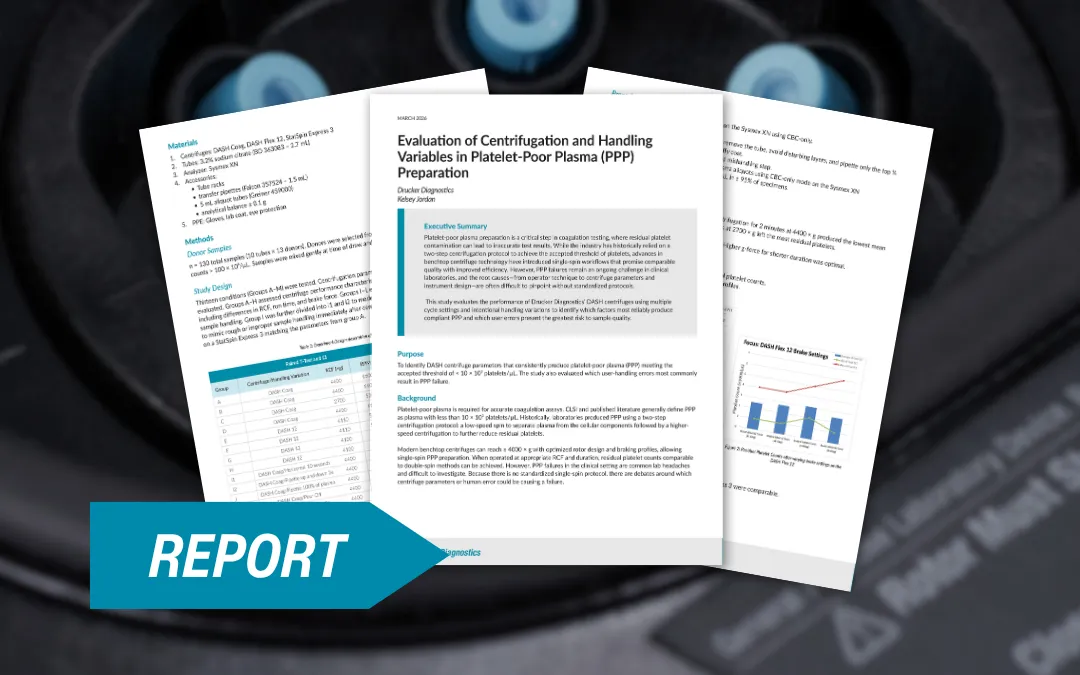
Evaluation of Centrifugation and Handling Variables in Platelet-Poor Plasma (PPP) Preparation
Published March 26, 2026Executive Summary
Platelet-poor plasma preparation is a critical step in coagulation testing, where residual platelet contamination can lead to inaccurate test results. While the industry has historically relied on a two-step centrifugation protocol to achieve the accepted threshold of platelets, advances in benchtop centrifuge technology have introduced single-spin workflows that promise comparable quality with improved efficiency. However, PPP failures remain an ongoing challenge in clinical laboratories, and the root causes—from operator technique to centrifuge parameters and instrument design—are often difficult to pinpoint without standardized protocols.
This study evaluates the performance of Drucker Diagnostics’ DASH centrifuges using multiple cycle settings and intentional handling variations to identify which factors most reliably produce compliant PPP and which user errors present the greatest risk to sample quality.
Purpose
To Identify DASH centrifuge parameters that consistently produce platelet-poor plasma (PPP) meeting the accepted threshold of < 10 × 10³ platelets/μL. The study also evaluated which user-handling errors most commonly result in PPP failure.
Read the Report