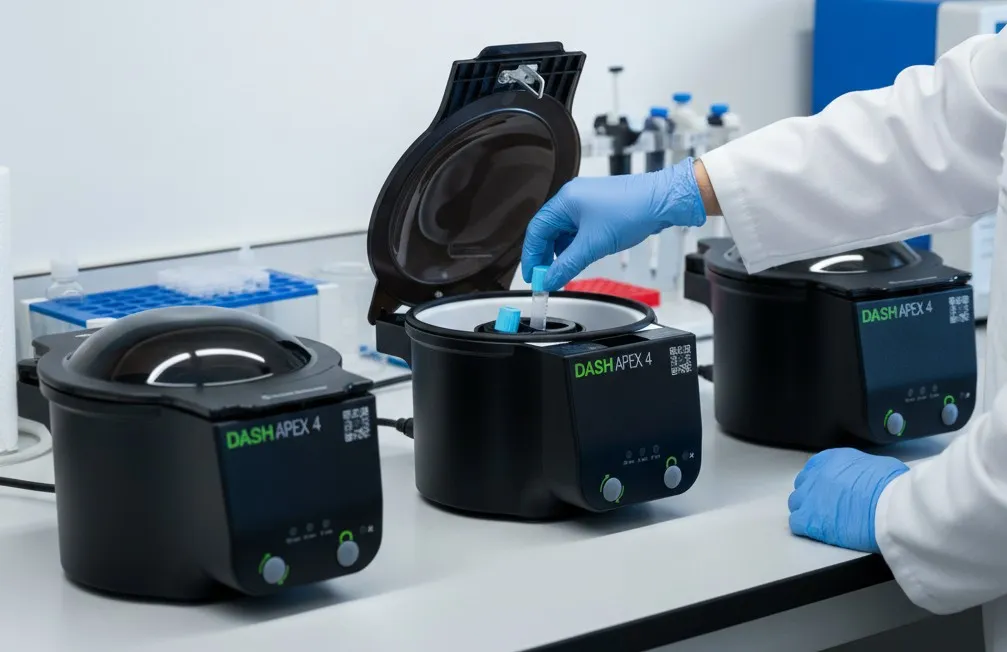
Best Lab Centrifuge for Small Labs: Compact Solutions That Don’t Compromise
Published January 16, 2026Small labs face a unique challenge: you need reliable centrifugation without the space or budget of larger facilities. The right centrifuge handles diverse applications, fits on limited bench space, and doesn’t require a team to operate.
This guide cuts through the noise to help you find centrifuges that actually work for small-lab realities.
TLDR:
- Versatile benchtop models beat specialized units for most small labs—handle multiple tube sizes without rotor swaps
- Measure your space first—you need 6″ clearance on all sides, plus room for lid opening
- Clinical labs: 3,000-4,000 RPM handles most blood work
- Research labs: 8,000-10,000 RPM for cell culture
- Ready-to-use designs eliminate rotor confusion and hidden adapter costs
- Budget $2,000-$8,000 for quality small-lab centrifuges
What Makes a Centrifuge Right for Small Labs?
Skip the enterprise-grade features you’ll never use. Focus on these priorities:
Compact footprint: 12-18″ benchtop models, not floor units that dominate the room.
Multi-application capability: One centrifuge handling blood tubes, cell culture, and microcentrifuge work beats owning three specialized units.
Simple operation: Multiple staff members should operate it without extensive training or programming headaches.
Appropriate capacity: Enough tubes for your daily volume, not theoretical maximum throughput you’ll never reach.
How Much Bench Space Do I Need?
More than the centrifuge’s listed dimensions suggest.
Calculate real space needs: A 14″ centrifuge needs 6″ clearance on all sides for ventilation. You’re really allocating 26″ of linear bench space, not 14″.
Check overhead clearance: Most benchtop centrifuges have backward-hinged lids. Measure the height to overhead cabinets before buying.
Practical tip: Use painter’s tape to outline the footprint (including clearances) on your actual bench. See if it works before ordering.
Benchtop or Microcentrifuge?
Choose a microcentrifuge if:
- You exclusively work with 0.2-2.0 mL tubes
- You need 12,000-16,000 RPM regularly
- Your protocols are primarily molecular biology
Choose a benchtop model if:
- You work with blood collection tubes (5-15 mL)
- Sample volumes vary between applications
- You handle both clinical and research protocols
For most small labs, the benchtop wins. You can accommodate smaller tubes with adapters, but you can’t spin large tubes in a microcentrifuge.
What Speed and Capacity Do I Actually Need?
Match your purchase to your protocols, not abstract “maximum capability.”
Clinical/veterinary blood work:
- 3,000-4,000 RPM for serum/plasma separation
- Capacity for 12-24 tubes (5-15 mL)
- Timer with auto-shutoff
Cell culture research:
- 8,000-10,000 RPM minimum for cell pelleting
- Variable speed control for different cell types
- At least 10,000 x g RCF rating
Mixed-use labs:
- 6,000-10,000 RPM range covers most applications
- Programmable presets save time on routine protocols
Often-overlooked spec: acceleration/deceleration rates. Gentler ramps matter for platelets and gradient work.
Top Compact Centrifuges for Small Labs
Here are models that balance space, versatility, and value. We favor Drucker (obviously), but we’re including competitor options for fair comparison.
Drucker DASH: Best All-Around Small Lab Centrifuge
Best for: Labs needing one centrifuge to handle blood tubes, micro tubes, and everything in between.
Why it works: The DASH eliminates rotor-swapping headaches. Its ready-to-use design accommodates various tube sizes through included adapters—no hunting for compatible rotors or second-guessing compatibility.
Specs:
- Max: 4,000 RPM / 2,410 x g
- Capacity: 12 x 15 mL or 8 x 7 mL tubes
- Footprint: 13.5″ x 13.8″
- Weight: 25 lbs (portable)
Strengths: Lightweight and movable, digital controls, quiet operation, significantly lower price than comparable models.
Limitations: Max speed suits clinical work but may limit some research applications. No refrigeration.
Ideal for: Veterinary clinics, small diagnostic labs, teaching labs, research facilities with primarily clinical protocols.
Drucker 642E Horizon: Best for Higher-Volume Clinical Work
Best for: Established small labs processing moderate daily blood sample volumes.
Why it works: More capacity than ultra-compact models without the bulk and cost of larger clinical centrifuges. Horizontal rotor ensures consistent separation across all tubes.
Specs:
- Max: 3,3380 RPM / 1,1600 x g
- Out of Box Capacity: 6 samples up to 10 mL
- Tube Sizes: Up to 16 x 100 mm or 10 mL, Up to 10 x 46 mm or 2 mL (with adapter sold separately)
- Footprint: 17″ x 15″
- Horizontal swing-out rotor
Strengths: Excellent separation quality, handles routine and larger tubes, simple durable design, timer with auto-shutoff.
Ideal for: Small hospital labs, reference labs processing 50-200 samples daily.
Hettich EBA 200
Best for: Labs wanting European manufacturing and willing to pay premium pricing.
Specs:
- Max: 6,000 RPM / 3,461 x g
- Capacity: 8 x 15 mL
- Digital display, safety lid lock
Limitations: Higher price point than Drucker models. Separate rotors required for different tube sizes (added cost and storage).
Ideal for: Established facilities with budget for premium equipment, labs prioritizing maximum speed flexibility.
Do I Need Refrigeration?
Refrigeration increases both cost and maintenance. Think carefully.
You need refrigeration if:
- You work with temperature-sensitive proteins/other analytes
- Protocols involve live cells that can’t tolerate heat
- Processing takes longer than 30 minutes at high speeds
You can skip refrigeration if:
- You primarily process blood for serum/plasma
- Spin times are short (under 30 minutes)
- Samples are stable at room temperature
Middle-ground approach: Keep a small refrigerated unit for critical work and add a non-refrigerated centrifuge for routine high-volume processing. Often costs less than one large refrigerated unit.
What About Rotor Compatibility?
This is where small labs waste money and time.
The problem: Many centrifuges require specific rotors for different tubes. Each rotor costs $400-$1,500, and you need space to store them.
The solution: Ready-to-use models with universal rotors or extensive included adapter kits. Switch from blood tubes to microcentrifuge tubes using adapters that came with the unit.
Questions before buying:
- What tube sizes does the standard rotor accommodate?
- Are adapters included or sold separately?
- Can I use off-the-shelf adapters or only proprietary ones?
For small labs, prioritize models that include adapters. The upfront cost difference is minimal, but long-term convenience and savings are substantial.
New vs. Used Centrifuges?
Used makes sense when:
- Buying from reputable lab equipment reseller (not auctions)
- Model is under 5 years old with maintenance records
- Seller offers 90-day warranty minimum
- You have service capability
Buy new when:
- This is your primary or only centrifuge (downtime is critical)
- Used price is only 20-30% less than new (insufficient savings for risk)
- You lack local service support
- You need warranty coverage for budget predictability
Red flags:
- No maintenance records
- Heavy cosmetic damage
- Unusual noises during test runs
- “Sold as-is” with no warranty
- Older than 7-10 years
Common Buying Mistakes
Buying on price alone: The cheapest option often lacks features you’ll need or fails prematurely. Focus on cost per year of reliable service.
Ignoring capacity growth: Build in 30-40% capacity buffer for future volume increases.
Forgetting about noise: In a small lab, a loud centrifuge becomes a constant irritation. Check decibel ratings.
Not measuring first: Verify the unit fits under overhead cabinets and has proper clearances before ordering.
Skipping the adapter inventory: Identify all tube types you’ll use before purchasing. Don’t get stuck ordering $400 adapters after the fact.
Final Thoughts
The best small-lab centrifuge reliably handles your daily workload without monopolizing space or budget. For most small clinical and veterinary labs, the Drucker DASH offers the best balance of capacity, ease of use, and value. Labs with more specialized needs—ultra-compact spaces, higher speeds, or larger volumes—will find better fits with the other options covered here.
Match the centrifuge to your specific situation rather than buying either the cheapest option or the most feature-packed model. A well-selected centrifuge should serve your lab reliably for 7-10 years—making it one of the better long-term investments in your facility.