
What to Look for When Buying a Veterinary Centrifuge for a Mixed-Animal Practice
Published June 16, 2026A mixed-animal practice processes a wider variety of sample sizes and species in a typical week than a single-species clinic, and the centrifuge has to keep up. The right unit reduces friction across that variety; the wrong one creates it every day. The buying decision is less about top speed and more about whether the configuration matches the actual caseload.
TLDR
- Mixed-animal practices run a wider variety of tube sizes and species samples than small-animal clinics, so rotor flexibility and tube capacity matter more than peak speed.
- The CLSI standard for general laboratory equipment maintenance, QMS23, defines the calibration, verification, and preventive maintenance framework that any clinical centrifuge should support.¹
- One well-chosen veterinary centrifuge handles most in-house diagnostics. Practices doing high-volume regenerative medicine or specialized large-animal work may benefit from a dedicated second unit.
Why is centrifuge selection harder for a mixed-animal practice?
A small-animal-only clinic can plan around a fairly narrow tube range, typically 0.5 to 5 mL collection tubes for routine chemistry and hematology. A mixed-animal practice can see canine bloodwork, feline urinalysis, equine plasma processing, and bovine hematocrit in the same day. Each species brings different sample volumes, different tube formats, and different protocol requirements.
The practical result is that mixed-practice buyers more often discover post-purchase that their centrifuge handles part of the caseload well and creates workarounds for the rest. The question to ask before buying is not “what is the maximum speed” but “what tube formats does this unit accept out of the box, and how many of them are in our current caseload.”
What does CLSI say about centrifuge selection and maintenance?
CLSI QMS23 covers performance qualifications, routine function checks, calibration verification, and preventive maintenance for general laboratory equipment, including centrifuges. It is the framework most clinical and veterinary laboratories follow for documenting equipment care. It specifically calls for timer accuracy verification against a calibrated stopwatch and speed verification across a range of operating speeds using a calibrated tachometer or stroboscopic light.1
In parallel, the College of American Pathologists checklists GEN.41017 and COM.30600 require that centrifuge operating speeds be verified and documented at least annually; for units with a lid-interlock safety mechanism, the speed check must be performed by an authorized manufacturer representative or clinical engineer.² For veterinary practices not subject to CAP requirements, these still represent a defensible baseline.
The practical implication for a buying decision is that a centrifuge worth buying should support these verification activities. If the displayed speed cannot be independently checked against a tachometer, or if the timer cannot be verified against a stopwatch, the unit creates a quality control gap that is difficult to close after purchase.
How wide a tube range does a mixed-animal centrifuge actually need to handle?
The honest answer depends on the caseload, but a defensible baseline for a mixed-animal practice covers four tube categories: capillary tubes for microhematocrit (typically 75 mm), small-volume tubes for in-house microcollection panels (0.5 to 2 mL), standard collection tubes for routine chemistry and hematology (3 to 15 mL), and larger tubes for large-animal samples or specialized work (up to 50 mL or more in some equine and bovine contexts).
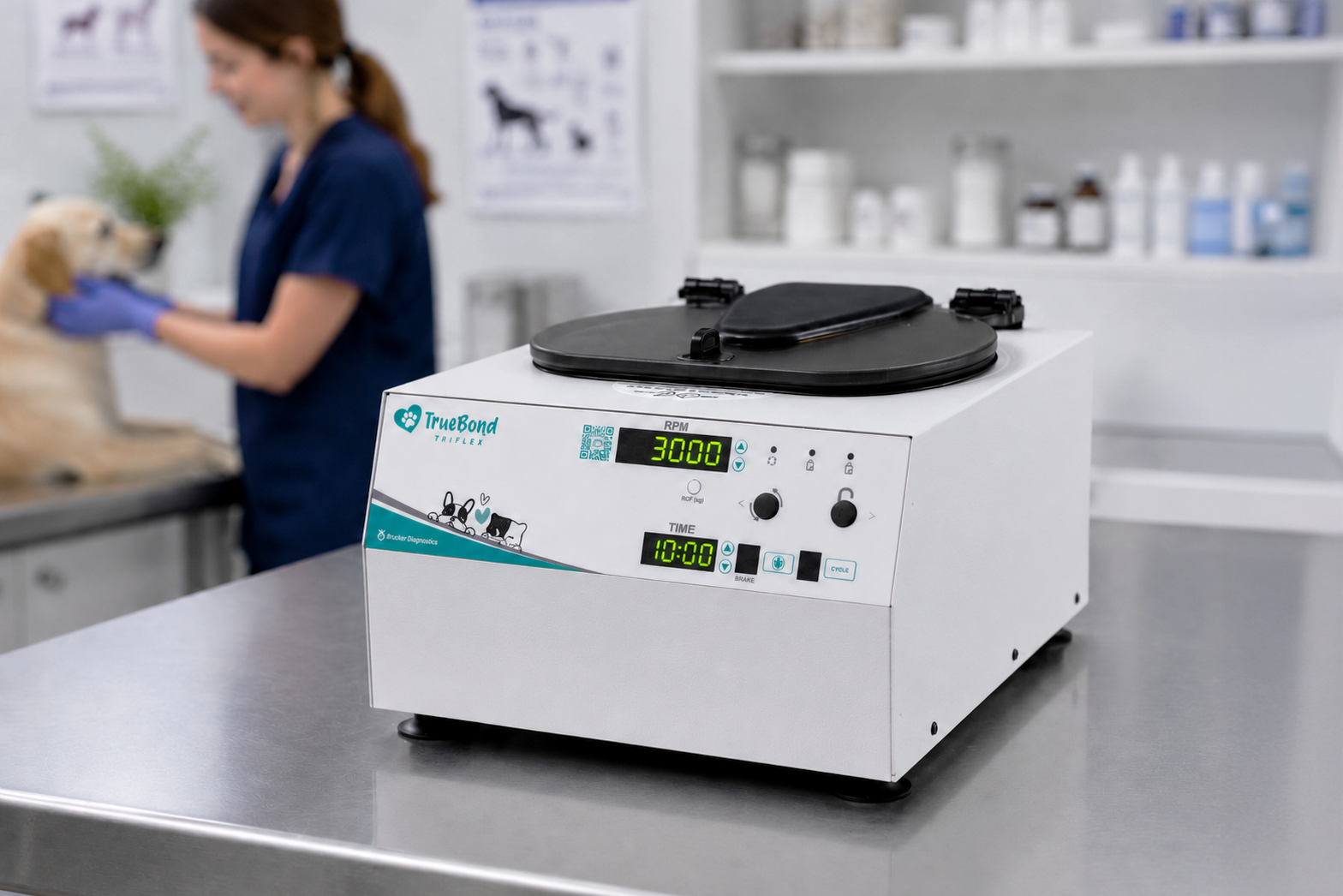
A centrifuge that handles all four categories in one rotor is a different proposition than one that handles two well and requires rotor swaps or adapter purchases for the others. As a concrete example, the TrueBond TriFLEX ships with out-of-box capacity for 8 microhematocrit tubes up to 75 mm, 8 samples up to 2 mL, 8 samples up to 15 mL, 2 samples up to 50 mL, and 2 samples up to 140 mL in the same rotor.³ That kind of multi-format capacity is what removes the friction described above; it does not require choosing in advance which tube size the unit will be configured for.
Does RCF matter more than RPM in mixed-animal work?
Yes, and the distinction matters more in a mixed-practice setting because protocols vary by sample type. RCF (relative centrifugal force or relative centrifugal field, expressed as × g) is the actual force applied to the sample. RPM is the rotor speed in revolutions per minute. The two are related through the reference radius:
RCF (× g) = 0.00001118 × r × N²
where r is the reference radius in centimeters and N is RPM.4
Two centrifuges running at the same displayed RPM can deliver different RCF values to the sample because their reference radii differ. This is why protocols written by reference laboratories, professional societies, or kit manufacturers specify RCF, not RPM. For a mixed-animal practice, the question to ask a centrifuge manufacturer is not “what RPM does this reach” but “what RCF does this deliver at the reference radius of the rotor you ship with it.”
BD specifies 1,000 to 1,300 × g for SST and PST serum- and plasma-separator tubes. BD Microtainer capillary tubes require a minimum of 2,000 × g for non-gel tubes and 6,000 to 15,000 × g for gel tubes. Both IFUs permit other speeds and times following laboratory validation.⁵,⁶Microhematocrit, PRP preparation, and other applications each have their own protocol-specific requirements that should be validated against the specific protocol and the manufacturer’s stated capability, rather than assumed transferable from one application to another.
Should a mixed-animal practice choose a fixed-angle or swing-out rotor?
The honest answer is that the choice depends on what the rotor will be asked to do, and for mixed-animal work, the more useful question is whether the centrifuge supports the rotor geometry the practice’s protocols actually call for.
A fixed-angle rotor holds tubes at a constant angle (typically 30 to 45 degrees) throughout the spin. Cells separate against the outer tube wall and deceleration can disturb the interface as the tube returns to vertical. Fixed-angle rotors run at higher speeds and have a smaller footprint, which suits routine serum and plasma separation in throughput-focused environments.
A horizontal (swing-out) rotor allows tubes to pivot outward to a horizontal position during the spin. The cell-plasma interface forms perpendicular to the tube and stays intact on deceleration, which produces cleaner separation. This matters for microhematocrit work, buffy coat preparation, and any application where the integrity of the separation interface affects the result, including PRP preparation where the buffy coat layer is the target.
For a mixed-animal practice, a centrifuge that handles horizontal microhematocrit and fixed-angle work for blood, urine, and fecal samples in the same rotor (such as the TrueBond TriFLEX’s configuration) removes the choice rather than forcing it.
What about the footprint, noise, and operating environment?
Veterinary treatment rooms and labs are rarely spacious. A centrifuge that takes up a foot or more of counter depth is a meaningful commitment, and a unit that vibrates or generates noticeable noise during operation is disruptive in a clinical environment where consultations or minor procedures may be happening nearby.
The TrueBond Set 3, as a point of reference, has a footprint of 12 by 14 inches and a height of 9 inches, which fits easily on most veterinary lab benches.7 The TriFLEX is larger by design because it accommodates the wider tube range and additional applications.3 Measure the available bench space before purchase, and confirm whether the manufacturer requires clearance on any side for ventilation.
Noise level is harder to evaluate from a spec sheet alone. Vibration during a spin can both disrupt the work environment and, over time, indicate mechanical imbalance that affects sample quality and shortens unit life. If the manufacturer publishes operating noise in decibels, that is useful; if not, asking for a live demonstration or reaching out to existing customers for real-world feedback is a more reliable indicator than published claims.
What should a veterinary practice ask about maintenance and service?
Three things, in order of importance.
First, what does the warranty cover and for how long? Drucker provides a 2-year parts and labor warranty as standard across the TrueBond line, with 1, 2, and 3-year extended warranties available for purchase within 90 days of the original ship date.7 A 2-year baseline is a reasonable expectation for a clinical centrifuge in this category; anything shorter warrants questions about expected service life.9
Second, where is service performed and how quickly? A US-based manufacturer with in-house service capability resolves issues faster than a unit that requires shipping to an overseas service center. Drucker’s service operation is based in central Pennsylvania, which matters for turnaround on warranty work and replacement parts.
Third, what is the carrier and rotor replacement framework? Drucker’s published guidance recommends carrier inspection on a schedule tied to weekly run volume: high-volume labs running 50 or more spins per week inspect carriers weekly; medium-volume labs running 20 to 50 spins per week inspect bi-weekly; low-volume labs running under 20 spins per week inspect monthly.8 That framework is more practically useful than a generic cycle-count number, because it ties inspection cadence to actual use.
Where does the buying decision most often go wrong?
The most common mistake is optimizing for upfront price and discovering the total cost of ownership later. A lower-priced unit that requires additional rotor purchases, adapter kits, or service contracts to cover the actual caseload can exceed the cost of a fully configured unit that ships ready to use.
The second most common mistake is buying for the current caseload without accounting for likely expansion. A practice currently focused on small-animal panels that plans to add equine work, expand into regenerative medicine, or grow into a larger-animal caseload is better served by a centrifuge with headroom in tube capacity and protocol flexibility than by one tightly configured for the present case mix.
The third is treating the centrifuge purchase as a transactional buy rather than as infrastructure. The right centrifuge runs reliably for years with documented maintenance. The wrong one creates friction or service issues every week.
When does a practice actually need a second centrifuge?
One well-configured veterinary centrifuge handles most mixed-practice diagnostic needs. There are two scenarios where a second unit makes practical sense.
The first is high-volume batching pressure. If a meaningful portion of the caseload involves time-sensitive processing where multiple samples need to be spun in parallel windows (large-animal plasma banking, pre-surgical panels across multiple patients), a dedicated second unit reduces the bottleneck that batching on a single centrifuge creates.
The second is high-volume regenerative medicine. For practices running occasional in-house PRP preparation as part of a broader veterinary caseload, a multi-application centrifuge like the TriFLEX handles both routine diagnostics and PRP in the same rotor. For practices building out a dedicated regenerative medicine program with higher-volume or more specialized protocols, a separate unit configured around the regenerative medicine workflow keeps both sides running without configuration switching.
The general principle: a second centrifuge is justified when the time cost of reconfiguring a single unit exceeds the cost of dedicating one to the higher-volume application.
Frequently asked questions
What RCF range does mixed-animal veterinary work typically require? BD specifies 1,000 to 1,300 × g for SST and PST serum- and plasma-separator tubes⁵ and, for Microtainer capillary tubes, a minimum of 2,000 × g (non-gel) or 6,000 to 15,000 × g (gel).⁶ Other speeds and times may be used following laboratory validation. Microhematocrit, PRP preparation, and other specialized applications each have their own RCF requirements that should be validated against the specific protocol and the manufacturer’s stated capability for the unit in use.
Can a human clinical centrifuge be used in a veterinary setting? In most cases yes, with two caveats. First, tube format compatibility: veterinary collection tubes are not always the same size as standard human collection tubes, and the rotor must accept the specific tube sizes the practice uses. Second, application coverage: a centrifuge configured for routine human serum work may not accommodate the wider tube range or the microhematocrit capability typical of mixed-animal practice.
How often should a veterinary centrifuge be calibrated? CLSI QMS23 recommends periodic verification of timer accuracy (using a calibrated stopwatch) and speed accuracy (using a calibrated tachometer or stroboscopic light) on a documented schedule.¹,² CAP checklists require at least annual verification for clinical laboratories.² Verification frequency otherwise varies by manufacturer: some specify biennial checks for speed and timer, with additional checks after relocation or service.⁹
Does a mixed-animal practice need a separate microhematocrit centrifuge? Not necessarily. Centrifuges configured for both horizontal microhematocrit and fixed-angle blood, urine, and fecal processing in the same rotor (such as the TrueBond TriFLEX) eliminate the need for a separate unit. Practices using a centrifuge without native microhematocrit capacity can sometimes add capability with a microhematocrit adapter kit.
What tube sizes should a mixed-animal centrifuge accommodate? At minimum: capillary tubes up to 75 mm for microhematocrit, microcollection tubes from 0.5 to 2 mL for small-animal panels, standard collection tubes from 3 to 15 mL for routine chemistry, and larger tubes (up to 50 mL or more) for large-animal samples. A centrifuge that handles this range natively, without requiring separate adapter purchases, is meaningfully more practical for mixed-animal work.
For a side-by-side look at the TrueBond family configurations, the Drucker veterinary centrifuge lineup covers the range from the compact Duet through the multi-application TriFLEX. To discuss a specific use case, contact the team directly.
References
- Clinical and Laboratory Standards Institute. General Laboratory Equipment Performance Qualification, Use, and Maintenance. CLSI guideline QMS23. Wayne, PA: CLSI. https://clsi.org/about/blog/general-laboratory-equipment-performance-qualification/
- College of American Pathologists. CAP Accreditation Checklists: GEN.41017 (Centrifuge Operating Speeds) and COM.30600. Northfield, IL: College of American Pathologists.
- Drucker Diagnostics. TrueBond TriFLEX Veterinary Centrifuge Product Specifications. Port Matilda, PA. https://druckerdiagnostics.com/product/truebond-triflex/
- Wilson K, Walker J, eds. Principles and Techniques of Biochemistry and Molecular Biology. Cambridge, UK: Cambridge University Press. Centrifugation (chapter 3).
- Becton, Dickinson and Company. BD Vacutainer Evacuated Blood Collection System: Instructions for Use. Franklin Lakes, NJ: BD; September 2020. Document VDP40161-WEB(10).
- Becton, Dickinson and Company. BD Microtainer Blood Collection Chemistry Tubes: Instructions for Use. Franklin Lakes, NJ: BD; February 2022. Document VDP40477(01).
- Drucker Diagnostics. TrueBond Set 3 Veterinary Centrifuge Product Specifications. Port Matilda, PA. https://druckerdiagnostics.com/product/truebond-set-3/
- Drucker Diagnostics. When Should I Replace My Centrifuge Carriers? Drucker Diagnostics Resources Blog, December 2025. https://druckerdiagnostics.com/resources/blog/when-should-i-replace-my-centrifuge-carriers/
- Drucker Diagnostics. Centrifuge Calibration Check: Step-by-Step Guide. Port Matilda, PA. https://druckerdiagnostics.com/resources/calibration-check/