
Why Smart Veterinary Practices Are Adding Bloodwork to Every Annual Exam
Published January 15, 2026Walk into any progressive veterinary practice today, and you’ll notice a shift: annual wellness exams now routinely include comprehensive bloodwork—even for seemingly healthy young adults.
This isn’t upselling. It’s a fundamental change driven by mounting evidence that annual bloodwork catches diseases years before clinical signs appear, establishes invaluable baseline data, and transforms the veterinarian-client relationship.
If you’re still reserving bloodwork primarily for sick pets and pre-anesthetic screening, you’re missing opportunities to provide better medicine, build stronger client relationships, and position your practice as a leader in preventive care.
TL;DR Summary: Routine bloodwork detects diseases in early, treatable stages before the majority of organ function is lost, establishes individual baseline values that make future changes meaningful, and provides the thorough preventive care modern pet owners expect. Implementation requires in-house laboratory capabilities—particularly a reliable centrifuge for processing samples—enabling same-day results that dramatically improve client experience and compliance. Beyond clinical benefits, routine bloodwork differentiates your practice from competitors and establishes long-term monitoring relationships that improve patient outcomes and practice stability.
Why Is Routine Bloodwork Becoming Standard Care?
The Clinical Reality: Symptoms Appear Too Late
Physical examination has blind spots:
-
Pets can lose the majority of kidney function before showing clinical signs like increased thirst or urination
-
Liver disease progresses silently until jaundice or neurological symptoms occur
-
Early diabetes presents only as slightly elevated glucose that normalizes with stress
-
Hyperthyroidism often mimics normal aging initially
-
Anemia develops gradually enough that pets compensate until it becomes severe
Bloodwork illuminates what you cannot see, feel, or hear with traditional examination.
The Evidence
Studies examining bloodwork in apparently healthy pets reveal surprising findings. A significant percentage of “healthy” adult pets show clinically significant bloodwork abnormalities, with this percentage increasing substantially in pets aged seven and older. Many represent early, treatable stages of disease.
Establishing baseline values when pets are definitively healthy provides context for interpreting future results—a “normal” value that changes significantly from baseline is often your earliest warning sign.
Client Expectations
Today’s pet owners view their animals as family members deserving of medical care comparable to human standards. They get annual bloodwork themselves and often question why it isn’t standard for their pets.
Practices offering comprehensive wellness protocols are perceived as more thorough and advanced. Those that skip bloodwork risk being perceived as outdated.
What Are the Strategic Benefits?
-
Transforms wellness visits from transactions to relationships
-
Without bloodwork: brief visit with history, exam, vaccinations, and the client leaves.
-
With bloodwork: extended discussion, sample collection, meaningful time reviewing results, collaborative decision-making, and follow-up planning.
-
You’re having substantive health management conversations, not transactional exchanges. Clients remember these interactions.
-
Creates long-term monitoring relationships
Once you establish baseline bloodwork and begin annual monitoring, bloodwork becomes expected rather than negotiated. You’re the health management partner, not just the “vaccine doctor.”
This is particularly valuable with senior pets requiring more frequent monitoring. Practices that establish this pattern early find dramatically higher compliance when frequent monitoring becomes critical.
Differentiates Your Practice
Comprehensive, progressive medicine attracts clients who prioritize quality over price—your most compliant, least price-sensitive, highest lifetime value clients.
Discussing bloodwork elevates the conversation. You’re interpreting complex data, explaining physiological concepts, and demonstrating expertise in ways clients can see and appreciate.
What About “But My Pet Is Young and Healthy”?
The Baseline Argument
Every individual has their own “normal” within reference ranges. Establishing individual normals at age 1-2 provides invaluable context for future testing. Without baseline data, you’re guessing whether a borderline value represents disease or individual variation.
Early-Onset Diseases Exist
Young pets can have portosystemic shunts, congenital kidney disease, breed-specific issues, early endocrine disorders, and blood parasites. These are more manageable when caught early.
Sets Expectations for Lifelong Care
Clients accustomed to annual bloodwork from youth don’t question it when it becomes medically critical. You’re establishing a culture of preventive care.
Pre-Anesthetic Benefit
Even young pets need anesthesia for dentals and spays. Recent baseline bloodwork provides safety data and eliminates last-minute testing that delays procedures.
How Do You Implement This Successfully?
In-House Laboratory Is Non-Negotiable
Routine bloodwork only works with same-day results.
Sending samples to reference labs and calling days later results in significantly lower follow-up compliance. Discussing results immediately before clients leave achieves much higher engagement and compliance rates.
Same-day results allow immediate treatment, dietary recommendations, and collaborative planning while clients are engaged.
Essential Equipment
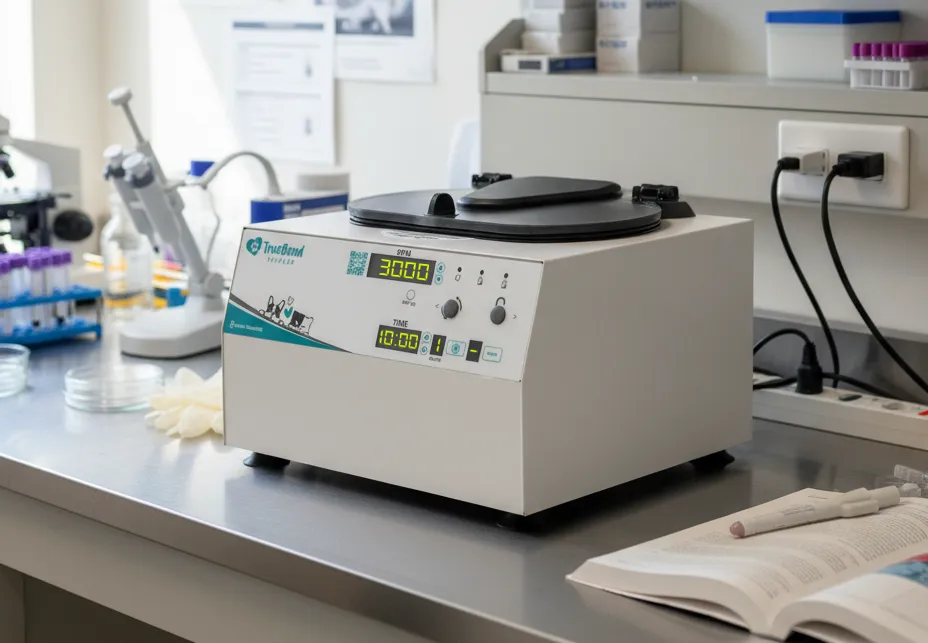
Centrifuge: You cannot run bloodwork without a centrifuge. Look for veterinary-specific models that handle multiple tube sizes, process blood/urine/fecal samples in one machine, and offer compact footprints.
Multipurpose centrifuges like the Drucker TrueBond series handle multiple sample types in one compact machine, eliminating the need for additional equipment. The TrueBond TriFLEX spins horizontal microhematocrit, urine, fecal, semen, and PRP in the same rotor, which are essential for routine wellness bloodwork.
Chemistry Analyzer: Basic benchtop analyzer for standard chemistry panels (12-15 parameters) plus electrolytes.
Protocols and Training
Create clear protocols:
-
Young adults (1-6 years): Annual comprehensive panel, baseline at age 1-2
-
Seniors (7+ years): Semi-annual panels, annual T4 for cats over 8
-
Pre-anesthetic: Minimum database for young patients, comprehensive for seniors
Train every team member on their role—veterinarians on interpretation, technicians on processing, receptionists on communication and pricing.
Client Communication
Position as standard care: “As part of Fluffy’s annual wellness exam, we’ll run bloodwork to check organ function” versus “Would you like bloodwork?”
Use age-appropriate messaging: Young pets get “establishing baseline”; adults get “annual screening”; seniors get “monitoring organ function.”
Connect to human medicine: “Just like your annual physical includes bloodwork, we recommend the same for pets.”
Are Normal Results Still Valuable?
Absolutely. Normal results:
-
Establish baseline for all future testing
-
Demonstrate thoroughness (you verify health, don’t assume it)
-
Create standard expectations (next year, bloodwork is routine)
-
Provide pre-anesthetic safety data
Change your language: Instead of “Everything looks good, see you next year,” say: “Fluffy’s exam is excellent, and her bloodwork confirms all organ systems are functioning perfectly. We’ve established her healthy baseline, so we can detect even subtle changes early when we recheck annually.”
How Does This Transform Client Relationships?
Creates Partnership
You and clients review objective data together. You explain what numbers mean. Clients participate in decision-making. Health management becomes collaborative, not prescriptive.
Builds Credibility
Objective data reduces skepticism. When you show elevated liver enzymes or abnormal kidney values, the need for intervention becomes evident.
The veterinarian who’s been monitoring mildly elevated kidney values for two years has far more credibility than one who suddenly announces kidney disease and needed treatment.
Enables Education
Discussing results allows you to explain organ function, aging vs. disease, and why dietary recommendations matter. You can show kidney values, not just suggest kidney diet.
Educated clients make better decisions and comply more consistently.
Common Implementation Pitfalls
Inconsistent Recommendations: If doctors in the same practice have different protocols, clients get confused. Solution: Develop clinic-wide standards.
Poor Sample Handling: Hemolysis, delayed processing, and improper centrifuge use waste reagents and produce inaccurate results. Solution: Invest in training and maintain quality control.
Weak Communication: Presenting bloodwork as optional with minimal explanation gets low compliance. Solution: Present as standard care with clear value explanation.
Not Discussing Normal Results: Only calling about abnormal results reduces perceived value. Solution: Every client gets a results discussion. Frame normal results as valuable confirmation.
Not Following Borderline Values: Noting elevated enzymes but not recommending follow-up leaves diseases unmonitored. Solution: Create clear protocols for borderline findings with scheduled rechecks.
What Does the Future Hold?
Rising Expectations: As human medicine focuses on preventive screening and early detection, pet owners expect the same. Practices offering comprehensive wellness care will be ahead of the curve.
Telemedicine Opportunities: You can’t perform physical exams through screens, but you can review bloodwork, discuss trends, and make informed recommendations remotely. Robust baseline data positions you for effective telemedicine.
Differentiation Matters: Corporate consolidation and low-cost clinics make differentiation critical. Comprehensive medicine—including routine bloodwork—distinguishes quality-focused practices from commodity providers.
Attracting Valuable Clients: Pet owners willing to invest in preventive care are more compliant, less price-sensitive, more loyal, and more likely to refer others. Comprehensive wellness programs naturally appeal to this demographic.
Adding bloodwork to annual pet exams isn’t just about catching diseases earlier—it’s about transforming how you practice veterinary medicine. The investment in in-house laboratory capabilities, particularly a quality centrifuge and chemistry analyzer, pays dividends through improved patient outcomes, stronger client relationships, and a practice positioned for the future of preventive care. The question isn’t whether to make this change, but how quickly you can implement it to start providing your patients with the comprehensive, progressive medicine they deserve.