
Best Veterinary Centrifuges for In-House Blood Testing
Published February 10, 2026Choosing a veterinary centrifuge affects daily workflow efficiency, test accuracy, and your ability to deliver timely care. The right model handles your clinic’s complete sample mix—blood, urine, fecal, and microhematocrit—without requiring staff to juggle multiple rotors or hunt for the right adapter.
TLDR
- Look for ready-to-use systems that include all necessary adapters and tube holders in the base price
- Match capacity to your daily volume: 2-sample units for mobile practices, 6-8 samples for standard clinics, multi-capacity models for high-volume operations
- Programmable cycles save time on routine tests; set-and-lock models offer simpler operation for smaller teams
What should I look for in a veterinary centrifuge?
Choose a centrifuge that spins all your common sample types—blood tubes, urine, fecal, and microhematocrit—in the same unit. The best veterinary centrifuges come ready to use with included adapters and tube holders, eliminating the complexity and hidden costs of matching rotors to tubes. This means your team can start processing samples immediately without sorting through accessory catalogs or waiting for additional shipments.
How much capacity do I need for my veterinary practice?
Most veterinary practices need 6-8 sample capacity for routine blood chemistry and urinalysis workflows. Mobile practices or low-volume satellite clinics work well with compact 2-sample units that prioritize microhematocrit testing. High-volume referral practices and specialty clinics benefit from models accommodating larger tubes up to 50-140 mL for therapeutic applications and custom protocols.
What’s the difference between programmable and set-and-lock centrifuges?
Programmable centrifuges with digital displays let you save up to 10 preset cycles for routine tests like blood chemistry panels, urinalysis, and fecal flotation. Your team selects the test type and the centrifuge automatically runs the correct speed and time. Set-and-lock models use mechanical timers with fixed speed settings—simpler operation means easier staff training and fewer buttons to navigate during busy appointments.
Understanding Veterinary Centrifuge Requirements
Sample Types Your Centrifuge Should Handle
Your centrifuge should accommodate your complete daily test menu without requiring rotor changes or accessory purchases:
- Microhematocrit tubes (40-75 mm) for packed cell volume testing and basic blood work evaluation. These small capillary tubes can be processed at a range of speeds—from 1,850 xg to 13,700 xg—depending on your centrifuge and specific testing protocol.
- Blood collection tubes (3-15 mL) for chemistry panels, serology, and general diagnostic workups. Most blood separation occurs at 1,200-2,000 xg, which is sufficient to separate serum or plasma from cellular components.
- Urine samples (5-15 mL) for sediment analysis and urinalysis. Lower speeds around 400-1,000 xg concentrate cells, crystals, and casts without damaging fragile cellular structures.
- Fecal samples (10-15 mL) for parasite screening and flotation procedures. Fecal flotation typically requires 400-650 xg to separate parasite eggs and larvae from debris.
- Larger volume tubes (50-140 mL) for practices offering therapeutic applications like PRP preparation or processing bulk samples for specialty testing.
Ready-to-Use vs. Accessory-Required Systems
Many centrifuges advertise attractive upfront pricing but require separate purchases of rotors, tube adapters, and holders. These accessory costs add up quickly and create setup complexity for your team. A blood tube holder costs $50-150, microhematocrit inserts run $75-200, and specialized adapters for different tube sizes can exceed $100 each.
Ready-to-use centrifuges include everything needed to start processing samples immediately. The box contains the rotor, all tube holders, adapters for different sample sizes, and microhematocrit inserts. Your team unpacks the unit, plugs it in, and begins spinning samples—no procurement delays, no compatibility questions, no surprise costs.
Footprint and Counter Space Considerations
Veterinary treatment areas face constant space pressure from diagnostic equipment, treatment supplies, and patient needs. Traditional clinical centrifuges occupy 2-3 square feet of counter space. Compact veterinary centrifuges compress this footprint to approximately 1-1.5 square feet while maintaining full functionality.
Consider placement near your most frequent testing area. Blood chemistry samples processed quickly during appointments improve client satisfaction and enable same-visit treatment decisions. Easy access reduces the temptation to batch samples, which can compromise some test results.
Speed and G-Force Requirements
Different veterinary tests require specific centrifugal force levels:
- Microhematocrit testing demands the highest speeds at 12,000-13,700 xg to pack red blood cells tightly for accurate PCV readings. Insufficient speed produces inaccurate hematocrit values.
- Serum or plasma separation from whole blood works well at 1,200-2,000 xg. Higher speeds aren’t necessary and may cause hemolysis in some samples.
- Urine sediment concentration requires gentler forces around 400-1,000 xg. Too much force can lyse red blood cells and white blood cells, making microscopic examination difficult.
- Fecal flotation performs best at 400-650 xg, allowing parasite eggs and oocysts to float to the surface while heavier debris settles.
Some centrifuges use fixed speeds optimized for veterinary applications. Others offer variable speed control, letting you dial in precise parameters for specialized protocols.
Veterinary Centrifuge Options by Practice Type
For Mobile and Small-Volume Practices
Mobile veterinarians and small satellite clinics need centrifuges that maximize functionality in minimal space. The priority shifts toward microhematocrit capacity for quick PCV checks and basic blood work, with compact dimensions that fit in vehicle storage or tight treatment areas.
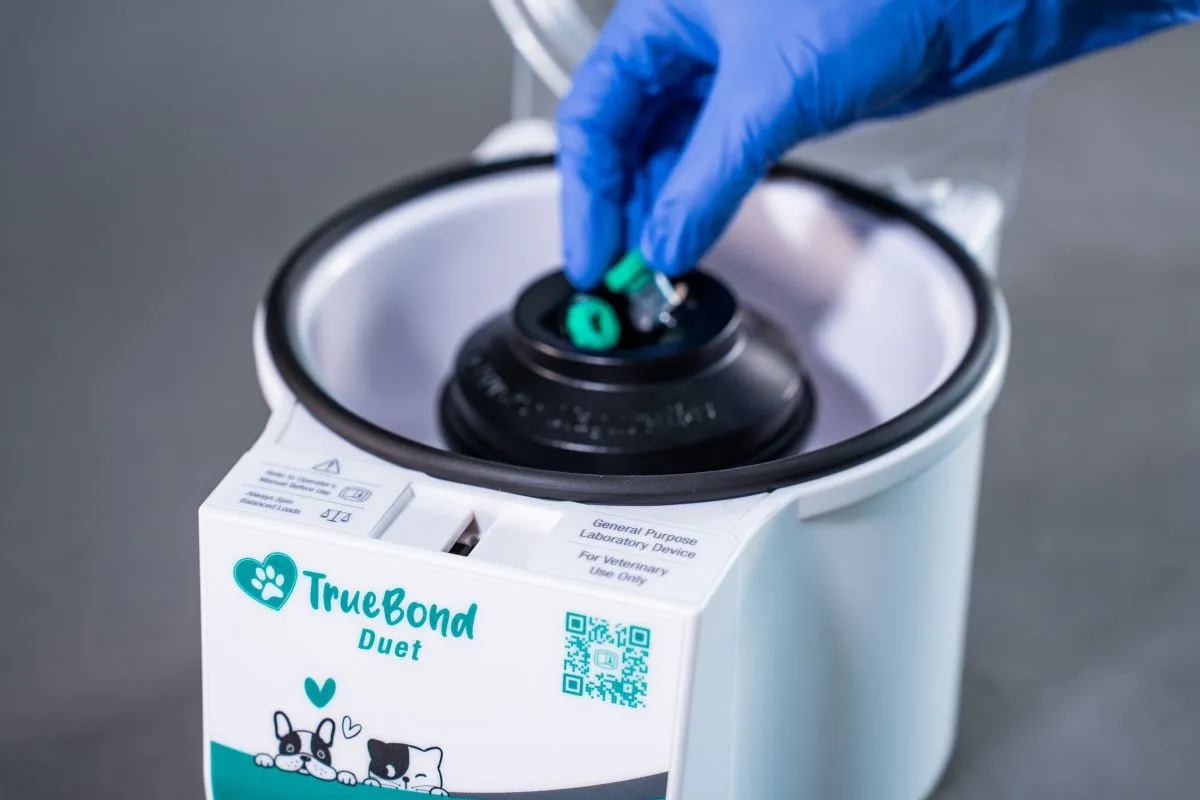
The TrueBond Duet offers dual-rotor design in an ultra-compact footprint. It spins 12 microhematocrit tubes at speeds up to 15,800 RPM (13,700 xg), making it the fastest option for high-volume PCV testing. The same unit also handles 2 blood or urine samples up to 2 mL when you need basic chemistry or urinalysis. Digital programmable controls let you save preset cycles for your most common tests.
This configuration works well for mobile practices where microhematocrit represents the majority of centrifugation needs, with occasional small-volume blood chemistry or urinalysis requests. The compact size fits easily in mobile units or practices with extremely limited counter space.
For General Veterinary Practices
Standard veterinary practices need reliable 6-8 sample capacity to handle daily blood chemistry panels, urinalysis, and fecal testing without creating processing bottlenecks during busy appointment schedules.
The TrueBond centrifuge processes 6 samples up to 15 mL plus 8 microhematocrit tubes in a compact 1.35 square foot footprint. Running at 3,900 RPM (1,850 xg), it handles routine blood separation, urine sediment concentration, and fecal flotation. The digital interface lets you program and save up to 10 custom cycles for your validated protocols—blood chemistry at 1,500 xg for 10 minutes, urinalysis at 400 xg for 5 minutes, fecal flotation at 500 xg for 5 minutes.
Staff can select the appropriate preset cycle rather than manually entering speed and time parameters for each sample type. This reduces operator error and ensures consistent processing across all team members and shifts.
For practices preferring simpler mechanical operation, the TrueBond Set 3 offers the same 6-sample and 8-microhematocrit capacity with set-and-lock controls. Instead of digital programming, it uses a mechanical timer and fixed speed setting. Turn the dial to set run time, close the lid, and the centrifuge automatically runs at the optimized speed for veterinary applications. This simplified operation means faster staff training and fewer opportunities for incorrect settings.
Both models arrive ready to use with all tube holders, adapters, and microhematocrit inserts included. Your team doesn’t need to match tube sizes to adapter part numbers or place separate accessory orders.
For High-Volume and Specialty Practices
Referral practices, emergency hospitals, and specialty clinics process higher daily volumes and encounter wider sample size variation. A patient might require standard blood chemistry (10 mL tubes), therapeutic PRP preparation (50 mL tubes), and custom research protocols (various sizes) all in the same day.
The TrueBond TriFLEX accommodates this sample diversity with a single rotor configuration:
- 8 samples up to 2 mL (microtubes, small custom collection tubes)
- 8 samples up to 15 mL (standard blood chemistry, urinalysis, fecal)
- 2 samples up to 50 mL (therapeutic applications, larger volume processing)
- 2 samples up to 140 mL (bulk sample preparation, specialty protocols)
- 8 microhematocrit tubes up to 75 mm
This range eliminates the need to switch rotors between sample types. A technician can load microhematocrit tubes, standard blood chemistry tubes, and a large-volume therapeutic sample into the same rotor for simultaneous processing. The removable rotor design allows practices to keep backup rotors on hand or customize configurations for specific applications.
Running at 4,000 RPM (2,950 xg), the TriFLEX provides sufficient force for routine veterinary separations while accommodating the speed requirements of various sample types. Digital controls offer full adjustment of speed, time, braking, and g-force, with four preset cycles for common veterinary applications plus the ability to program custom protocols.
For practices replacing discontinued Triac centrifuges, the TriFLEX serves as a direct modern replacement with expanded capacity and digital controls.
Making the Right Centrifuge Choice for Your Practice
The best veterinary centrifuge matches your daily workflow without forcing staff to think about equipment operation. Consider these practical factors:
- Daily sample volume determines whether you need 2, 6, or 8+ sample capacity. Practices running 5-10 chemistry panels daily rarely face capacity constraints with 6-sample models. Referral practices processing 20+ samples per day benefit from larger capacity or faster turnaround times.
- Sample type distribution matters more than total volume. Practices performing mostly microhematocrit testing prioritize high microhematocrit capacity over large tube accommodation. Mixed practices need balanced capacity across sample types.
- Counter space availability often becomes the limiting factor in equipment decisions. Measure your available space before evaluating models. A powerful centrifuge that doesn’t fit your workspace creates problems rather than solving them.
- Staff technical comfort influences whether programmable digital controls or simpler set-and-lock operation makes more sense. Practices with high staff turnover or part-time technicians may prefer straightforward mechanical controls. Practices with consistent experienced staff can leverage programmable presets for efficiency gains.
- Total cost of ownership extends beyond purchase price. Verify what accessories come included versus requiring separate purchase. Check warranty coverage—two-year parts and labor protection is standard for quality units. Ask about calibration requirements and costs, typically needed every two years or 5,000 cycles.
Ready-to-use centrifuges eliminate the complexity of matching equipment to applications. Your team focuses on patient care rather than equipment configuration, and same-visit diagnostic results improve client satisfaction while enabling timely treatment decisions.