
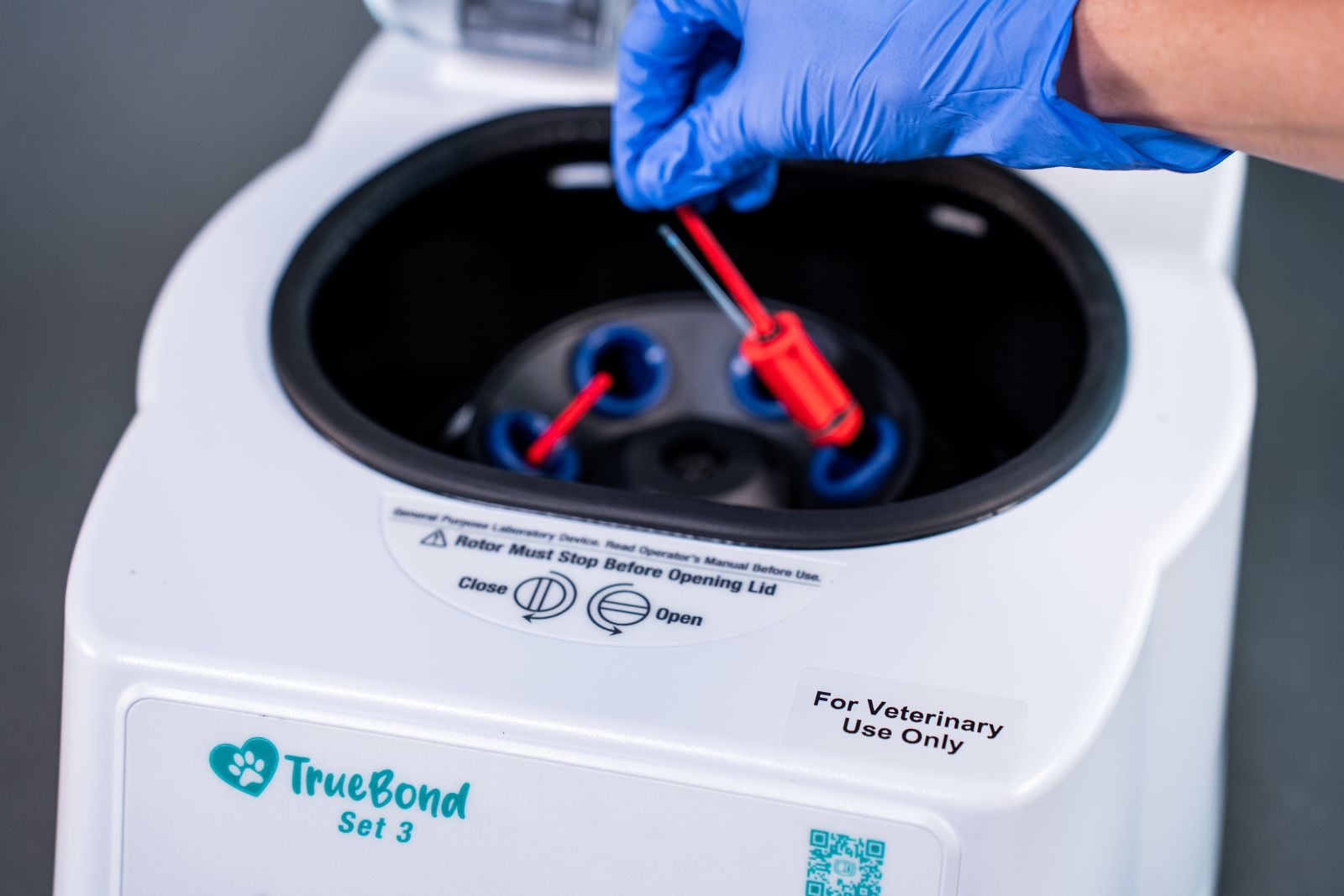
TrueBond vs. LW Scientific E8: Side-by-Side Comparison for Veterinary Labs
Published April 20, 2026If you’re comparing veterinary centrifuges and the LW Scientific E8 is on your shortlist, here’s how it stacks up against TrueBond. The E8 comes in two relevant configurations: Combination Variable Speed and Combination Touch, each with a direct TrueBond counterpart worth evaluating side by side.
TLDR
- Both TrueBond models reach higher max speeds than either E8 (3,900 RPM / 1,850 xg vs. 3,500 RPM / 1,534 xg)
- The E8 Combination holds 8 standard tubes per run vs. 6 for TrueBond, but switches between blood and hematocrit by swapping rotors
- The E8 Variable Speed has no preset cycles; TrueBond Set 3 ships with three factory-programmed cycles
- TrueBond carries a 2-year warranty with a calibration guarantee; the E8’s warranty coverage is limited to 1 year on electronics per distributor documentation
What is the LW Scientific E8?
The LW Scientific E8 is a fixed-angle, 8-place centrifuge designed, engineered, and assembled in Lawrenceville, Georgia. It’s built around a 12V DC brushless motor with auto-calibrating speed control and an auto-brake that stops the rotor in under 30 seconds. The E8 comes in three control variants — Fixed Speed, Variable Speed, and Touch (digital) — and in several accessory bundles. The Combination bundle is the most relevant for veterinary use: it adds crit carriers for 75mm microhematocrit tubes, microtube inserts for 1–2mL samples, and an EZ Reader card to the standard 15mL and 13x75mm tube sleeves.
The E8 is a genuinely capable, American-made centrifuge with a loyal following in small clinic and veterinary settings. The comparison below focuses on where the two platforms differ and where those differences matter for day-to-day workflow.
TrueBond Set 3 vs. LW E8 Combination Variable Speed
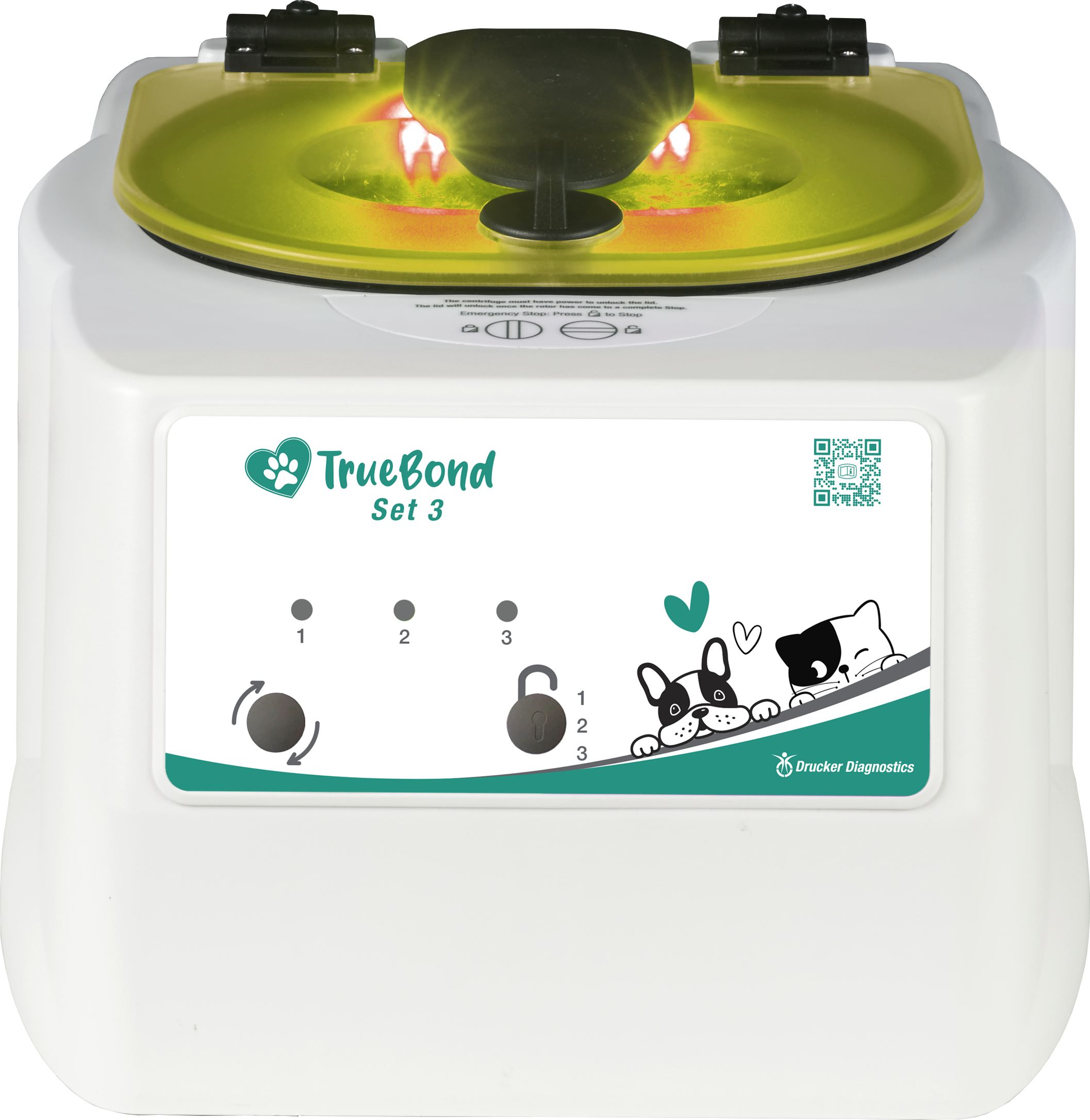
The E8 Combination Variable Speed uses a 2-dial interface. Speed and time are set manually on every run with no preset cycles. TrueBond Set 3 uses a 2-button interface with three factory-programmed cycles covering the most common veterinary workflows.
 |  |
|
|---|---|---|
| TrueBond Set 3 | LW E8 Combination Variable Speed | |
| Interface | 2-Button, 3-Setting | 2-Dial |
| Preset Cycles Time / RPM / RCF | 10 min / 3900 RPM / 1650 xg 5 min / 2000 RPM / 425 xg 6 min / 3800 RPM / 1550 xg | N/A |
| Max Speed RPM / RCF | 3,900 / 1,850 xg | 3,500 / 1,534 xg |
| Rotor Type | Fixed Angle | Fixed Angle |
| Microhematocrit (75mm) | 8 / 24* | 8 (2 x 4-place crit carriers, rotor swap required) |
| Up to 100mm or 10 mL | 6 | 8 |
| Up to 125mm or 15 mL | 6 | 8 |
| Timer | Preset cycles | 30-min auto-off with bell |
| Includes | Rotor, 16 x 100 mm carriers, 16 x 125 mm carriers, 1-1.5 mL microtube adapters, microhematocrit adapters, veterinary microhematocrit reader card | Rotor, 15mL sleeves, 13x75mm inserts, crit carriers, 1–2mL inserts, EZ Reader |
| Dimensions (W x D x H) | 12 x 14 x 9 in | 11 x 11 x 9.5 in |
| Warranty | 2-year + calibration guarantee. Extended Warranty options available | Limited lifetime / 1-year electronics† |
| Made in USA | Yes (Phillipsburg, PA) | Yes (Lawrenceville, GA) |
* Per distributor documentation; verify directly with LW Scientific
TrueBond vs. LW E8 Combination Touch
Both units use a digital interface with multiple preset cycles. The E8 Touch is programmable via touchscreen with a 10-setting memory; TrueBond uses a 10-setting digital interface with factory-loaded cycles. TrueBond reaches higher max speed and RCF and includes a lower-speed urine preset the E8 Touch’s factory settings don’t cover.
 |  |
|
|---|---|---|
| TrueBond | LW E8 Combination Touch | |
| Interface | Digital, 10-Setting | Digital, 10-Setting |
| Preset Cycles Time / RPM / RCF | 10 min / 3900 RPM / 1650 xg 5 min / 2000 RPM / 500 xg 5 min / 1600 RPM / 300 xg 6 min / 3800 RPM / 1550 xg | 10 min / 3500 RPM / 1534 xg 5 min / 1800 RPM / 406 xg 6 min / 1500 RPM / 282 xg 6 min / 3500 RPM / 1534 xg |
| Max Speed RPM / RCF | 3,900 / 1,850 xg | 3,500 / 1,534 xg |
| Rotor Type | Fixed Angle | Fixed Angle |
| Microhematocrit (75mm) | 8 / 24* | 8 (2 x 4-place crit carriers, rotor swap required) |
| Up to 100mm or 10 mL | 6 | 8 |
| Up to 125mm or 15 mL | 6 | 8 |
| Includes | Rotor, 16 x 100 mm carriers, 16 x 125 mm carriers, 1-1.5 mL microtube adapters, microhematocrit adapters, veterinary microhematocrit reader card | Rotor, 15mL sleeves, 13x75mm inserts, crit carriers, 1–2mL inserts, EZ Reader |
| Dimensions (W x D x H) | 12 x 14 x 9 in | 11 x 11 x 9.5 in |
| Warranty | 2-year + calibration guarantee. Extended Warranty options available | Limited lifetime / 1-year electronics† |
| Made in USA | Yes (Phillipsburg, PA) | Yes (Lawrenceville, GA) |
* Per distributor documentation; verify directly with LW Scientific
Does the LW E8 require rotor changes between applications?
Yes. The E8 Combination is described by LW Scientific as having interchangeable rotors. You switch between the standard tube rotor and the crit carriers depending on what you’re spinning. That means if your workflow moves between blood tubes and microhematocrit in the same session, you’ll be stopping to swap hardware between runs.
TrueBond handles blood tubes, microhematocrit, and urine in a single rotor configuration without changes between applications. For a busy clinic running mixed samples throughout the day, that’s time back in every shift.
What does “Combination” mean on the LW E8?
LW Scientific sells the E8 in three bundle tiers. The standard E8 ships with the 8-place rotor, 15mL tube sleeves, and 13x75mm inserts. The Combination bundle adds the crit carriers for microhematocrit, 1–2mL microtube inserts, and an EZ Reader card. If you’re comparing the E8 to TrueBond for a vet clinic, the Combination is the right comparison point. The standard E8 alone can’t spin microhematocrit tubes without a separate accessory purchase.
How do the preset cycles compare?
This is one of the clearest practical differences between the two platforms.
The E8 Variable Speed has no preset cycles at all. Speed and time are dialed in manually before every run, which introduces variability anytime a different staff member sets up the centrifuge. For practices following standardized protocols, which most accredited clinics are, that’s a documentation and consistency problem.
The E8 Touch is programmable and can recall the last four cycles used, which gives it more repeatability than the Variable Speed but still requires initial programming by the user.
TrueBond Set 3 ships with three factory-loaded cycles matched to common veterinary applications. TrueBond (the digital model) ships with four. Neither requires programming before first use. They’re ready to run the day they arrive.
Which is better for a high-volume veterinary practice?
It depends on what’s creating the bottleneck. If you’re processing a large number of patients in quick succession and tube count per run is the constraint, the E8’s 8-tube capacity gives it a batch-size edge over TrueBond’s 6 positions for standard tubes. At 8 tubes per run vs. 6, you’ll fit roughly 33% more samples into each cycle at the same run time.
If the bottleneck is consistency, setup time, or staff variability, especially in a multi-technician practice, TrueBond’s preset cycles and ready-to-run configuration tend to win. There’s no speed dialing, no programming, and no accessory sourcing before first use.
For practices that run microhematocrit and blood tubes in the same workflow, the rotor swap requirement on the E8 Combination is also worth factoring in. TrueBond handles both without interruption.
Why do veterinary practices choose TrueBond over the LW E8?
Higher max speed and RCF. Both TrueBond models outperform both E8 configurations: 3,900 RPM / 1,850 xg vs. 3,500 RPM / 1,534 xg.
Preset cycles on every model. TrueBond Set 3 ships with three factory-programmed cycles. The E8 Variable Speed has none. Every run requires manual setup, which introduces variability across staff and shifts.
No rotor swapping between applications. Blood tubes, microhematocrit, and urine all run in TrueBond’s standard configuration. The E8 Combination requires swapping rotors to move between test tube and hematocrit workflows.
Ready to run on day one. TrueBond ships with all accessories included. No programming, no separate orders, no compatibility research are required before the first spin.
2-year warranty with calibration guarantee. TrueBond’s warranty covers the full unit for two years and includes a calibration guarantee. Extended warranty options are also available. The E8’s warranty is reported as limited lifetime coverage with only 1 year on electronics.
Designed, built, and supported in the USA. Drucker Diagnostics is located in Pennsylvania, which means you get direct manufacturer support, not a distributor call queue.
Replacing an LW E8 or adding a centrifuge to your clinic? Contact Drucker Diagnostics to find the right TrueBond for your practice.