
How to Choose a Serological Centrifuge: Essential Features Guide
Published January 27, 2025Blood banking centrifuges are important tools for diagnosing diseases, ensuring the safety of blood transfusions, and performing critical procedures like blood grouping and typing. When selecting a centrifuge for the serology lab, we believe it’s important to prioritize accuracy and efficiency, and processes that fit seamlessly into existing workflows. But with numerous models on the market, what features should you prioritize? Here are the top features to look for when choosing a serological centrifuge.
1. Precision and Consistency
One of the most critical features of any serological centrifuge is its ability to deliver consistent and reliable results. Serology testing involves sensitive procedures where even small inconsistencies can lead to inaccurate results. A high-quality centrifuge should deliver stable and repeatable results, ensuring every spin meets exacting standards.
A high-quality centrifuge should deliver stable and repeatable results, ensuring every spin meets exacting standards. Look for models with:
- Precise speed control that maintains set RPM throughout the run
- Temperature stability to prevent sample degradation
- Minimal vibration that could disrupt delicate serological reactions
- Consistent acceleration and deceleration to protect cell integrity
2. High-Speed Capability for Quick Turnaround
In busy labs, turnaround time matters. A centrifuge capable of operating at high speeds without compromising sample integrity allows for quicker results, which is especially important in time-sensitive scenarios like blood banking and transfusion preparation. Adjustable speed settings are a valuable feature, as they allow you to tailor operations to meet your lab’s specific needs.
Adjustable speed settings are a valuable feature, as they allow you to tailor operations to meet your lab’s specific needs. Different serological tests require different centrifugation speeds—blood typing may need gentler speeds while crossmatching requires more force. The ability to program and save multiple protocols saves time and reduces operator error.
3. Versatility and Multiple Rotor Options
Not all labs work with the same type of samples, and a centrifuge that can handle multiple tube sizes and types is a significant advantage. The best centrifuges offer flexible rotor systems that enable seamless integration into various workflows.
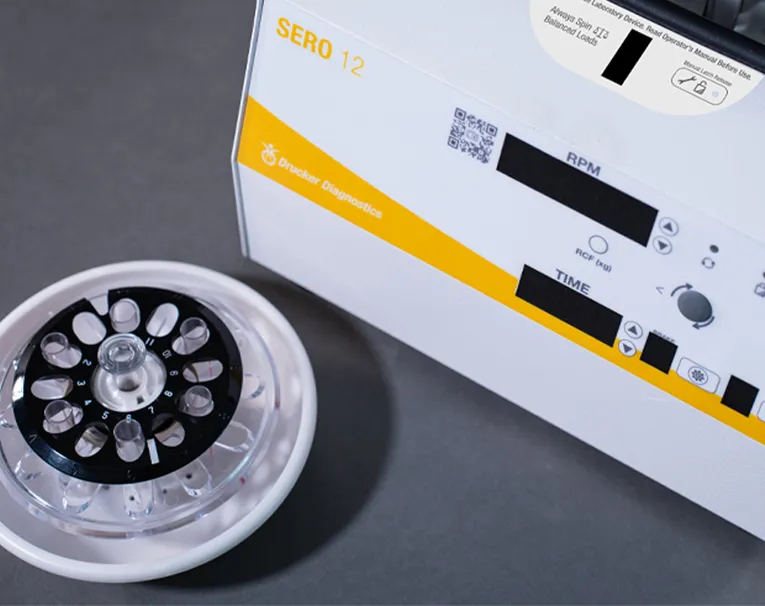
Look for options that allow you to batch, spin, transport, and incubate tubes in the same rotor. This streamlines lab operations and reduces the risk of contamination from transferring samples between containers. Some centrifuges, like the SERO 12 blood banking centrifuge, even offer removable rotors to further enhance versatility—allowing you to prep samples in one rotor while another is spinning.
Consider whether the centrifuge accommodates:
- Standard blood collection tubes (13mm, 16mm)
- Microtubes for smaller sample volumes
- Gel barrier tubes commonly used in serology
- Test tubes for traditional serological methods

The SERO 12 serological centrifuge has been carefully designed to facilitate high-quality blood grouping, typing, cross matching, and other cell-washing procedures for a wide range of tube sizes.
4. User-Friendly Interface and Easy Operation
A centrifuge should make your job easier, not harder. Look for a model with an intuitive, user-friendly interface that minimizes the learning curve for your team.
Key usability features include:
- Programmable settings – Save frequently used protocols to eliminate manual input for routine tests
- Digital displays – Clear readouts of speed, time, and g-force
- Simple controls – Straightforward buttons or touchscreen interfaces that reduce training time
- Run history tracking – Some models log previous runs for quality control documentation
These features significantly reduce the potential for errors while saving time on training and day-to-day use.
5. Capacity and Sample Throughput
Serology labs often deal with large sample volumes, so capacity is a key consideration. A centrifuge that can process a significant number of tubes in one run ensures that your lab keeps up with demand without creating bottlenecks in the workflow.
Pay attention to both the rotor’s capacity (how many tubes it holds) and the centrifuge’s ability to maintain consistent performance, even under heavy workloads. High-volume labs may need centrifuges that can handle 24+ tubes per run, while smaller facilities might prioritize flexibility over maximum capacity.
6. Easy Maintenance and Support
Even the best centrifuges require maintenance to continue performing at their peak. Models with accessible components and simple cleaning procedures can save your lab significant time and effort.
Consider these support factors:
- Ease of rotor removal and cleaning – Daily maintenance shouldn’t require tools or technical expertise
- Parts availability – Common wear items should be readily available
- Manufacturer support – Look for companies with responsive technical support and clear warranty policies
- Service network – Domestic support centers provide faster service than international manufacturers
At Drucker Diagnostics, our servicing center is located in Central Pennsylvania, ensuring that expert help is always just a phone call away. We offer strong after-sales support, keeping our centrifuges reliable for years to come.
7. Compact Design for Space-Saving
Space is often limited in lab environments, making a compact centrifuge an attractive choice. Compact models with high functionality allow you to maximize your lab’s efficiency without sacrificing valuable workspace.
This feature is particularly important for:
- Smaller serology or blood bank labs with limited bench space
- Mobile blood collection units
- Labs looking to optimize workflow in confined areas
- Facilities adding capacity without facility expansion
A smaller footprint doesn’t have to mean reduced capability—many modern centrifuges deliver full performance in space-saving designs.
8. Safety Features
Safety is crucial when working with potentially hazardous materials like blood products. Choose a centrifuge with built-in safety features that protect both your samples and your team.
Critical safety features include:
- Automatic lid locks – Prevent opening during operation
- Imbalance detection – Stops the run if tubes are loaded unevenly
- Emergency stop functions – Allow immediate shutdown if problems arise
- Aerosol-tight rotors – Contain potential biohazards during high-speed spinning
- Over-speed protection – Prevents the rotor from exceeding safe limits
These safeguards ensure that the centrifuge always operates securely, protecting laboratory personnel and maintaining sample integrity.
9. Durability and Long-Term Performance
A good centrifuge is an investment that should last for many years. Durability is essential in a high-usage environment, so look for centrifuges made from robust materials with a proven track record of reliability.
Routine maintenance should be straightforward to minimize downtime and extend the lifespan of the machine. Well-built centrifuges from reputable manufacturers can serve labs reliably for a decade or more with proper care.
10. Cost-Effectiveness and Value
While upfront costs are an important factor, consider the overall value a centrifuge brings to your lab.
Consider total cost of ownership:
- Initial purchase price vs. expected lifespan
- Energy efficiency for ongoing operational costs
- Maintenance requirements and parts costs
- Warranty coverage and length
- Productivity gains from faster processing and fewer errors
Features like high durability, versatile rotor options, and user-friendly designs can significantly reduce operational costs over time. A well-designed centrifuge can pay for itself by boosting productivity and minimizing errors.
The SERO 12: Built for Blood Banking Excellence
The SERO 12 serological centrifuge has been carefully designed to facilitate high-quality blood grouping, typing, crossmatching, and other cell-washing procedures for a wide range of tube sizes. It offers all the features discussed above—precision, speed, versatility, ease of use, and comprehensive safety features.
When choosing a serology centrifuge, it’s important to look for features that support accuracy, speed, flexibility, and safety—qualities that are crucial for your lab’s success. The SERO 12 offers all these advantages and more, making it an ideal solution for serology and blood banking labs. From its precision and consistency to its user-friendly design and unbeatable support, the SERO 12 is equipped to handle the diverse needs of modern laboratories.
Ready to enhance your lab’s performance and streamline your workflow? Learn more about the SERO 12 or contact our sales team at [email protected] for more information. We can also be reached by phone at +1-866-265-1486 (US Toll-Free).