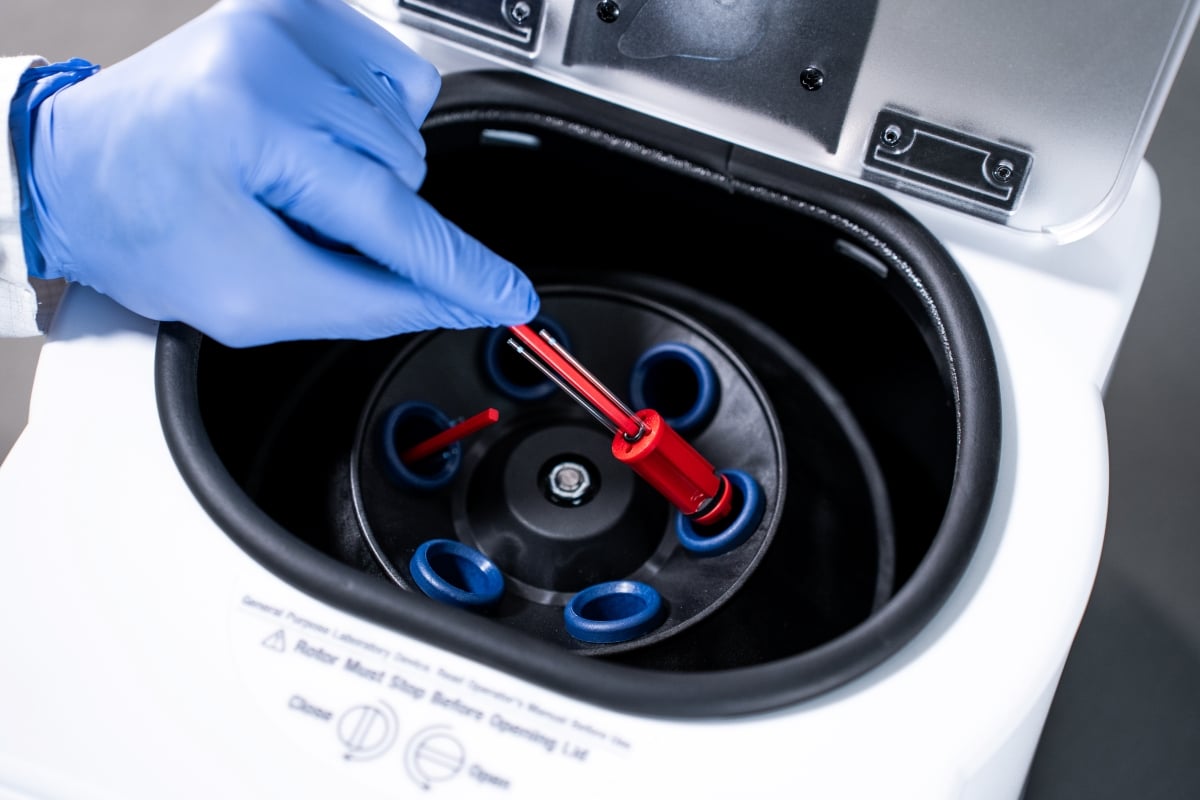
Microhematocrit Centrifuge for Veterinary Practices: What You Need and Why
Published June 30, 2026A microhematocrit centrifuge is a compact, high-speed centrifuge purpose-built to spin sealed capillary tubes for direct measurement of packed cell volume (PCV). In a busy veterinary practice, it is one of the few in-house tests that delivers clinically actionable information in minutes from a sample volume small enough to draw from almost any patient.
TLDR
- A microhematocrit centrifuge spins capillary tubes at high speed to separate red blood cells from plasma, producing a directly measured PCV value.
- The CLSI defines the microhematocrit method and the specific calibration and verification steps required for accurate results.¹
- Standard benchtop clinical centrifuges are not interchangeable with microhematocrit centrifuges; the difference is in the achievable relative centrifugal field (RCF), the rotor geometry, and the resulting completeness of red cell packing.
What does a microhematocrit centrifuge actually measure?
The PCV is the ratio of the volume occupied by red blood cells to the volume of whole blood in a sample, expressed as a fraction or percentage.¹ The microhematocrit method determines that ratio by spinning a small volume of anticoagulated whole blood in a capillary tube at high speed until the cellular components have separated into a packed column at the closed end of the tube. The length of that column relative to the total length of the blood column is the PCV.
CLSI distinguishes the terms PCV and hematocrit deliberately. PCV refers specifically to the quantity measured by centrifugation. Hematocrit is the broader term that also covers values derived indirectly by automated analyzers from red cell count and mean cell volume.¹ This distinction is maintained in veterinary clinical pathology, where reference laboratories report PCV measured directly by microhematocrit separately from the analyzer-derived hematocrit.² Although CLSI H07-A3 was written for human clinical laboratories, it specifies the microhematocrit procedure and centrifuge performance rather than any species-specific protocol, and veterinary clinical pathology applies the same CLSI specifications to animal samples.¹⁴ For practitioners using a microhematocrit centrifuge, PCV is the more technically accurate label.
PCV is one of the most clinically useful directly measured values in veterinary medicine. It screens for anemia and polycythemia, supports triage in critically ill patients, monitors response to therapy, and contributes to assessment of hydration status. Because the test uses approximately 50 µL of whole blood, requires no analyzer, and produces a visible result within minutes, it fits the workflow of practices that need fast answers without sending samples out.
How does the test work, step by step?
The procedure has three components: a properly filled and sealed capillary tube, a centrifuge operating at calibrated parameters, and a reading device for translating the spun column into a numeric result.
A capillary tube is filled with whole blood, either drawn directly from a skin puncture into a heparinized tube or from a separately collected EDTA sample into a plain tube. One end is sealed with clay, the tube is loaded into the centrifuge with the sealed end against the outer rim of the rotor, and the centrifuge is run for the manufacturer-specified time and speed. After centrifugation, three components are visible in the tube: a packed red cell column at the bottom, a thin buffy coat of leukocytes and platelets above it, and plasma at the top.
The result is read using a microhematocrit reader, which aligns the bottom of the red cell column with zero and the top of the plasma column with 100. The position of the top of the red cell column on that scale is the PCV, expressed as a percentage.
A practical reference point for interpreting results: the Animal Health Diagnostic Center at Cornell University publishes adult reference intervals for PCV measured directly by microhematocrit, including 42 to 54 percent for canine, 31 to 48 percent for feline, 31 to 48 percent for equine, and 24 to 37 percent for bovine.² These are laboratory-specific intervals established on healthy adult animals; values outside these ranges in a clinical context warrant follow-up.
Why does the relative centrifugal field matter more than RPM?
The force exerted on the sample during centrifugation is RCF (sometimes called relative centrifugal field), not RPM. CLSI H07-A3 defines RCF as the outward-directed centrifugal acceleration of an object moving in a circle at constant angular velocity, calculated as:
RCF (× g) = 0.00001118 × r × N²
where r is the reference radius in centimeters and N is the rotor speed in revolutions per minute.¹ Because centrifugal force increases with distance from the axis of rotation, the RCF acting on the sample varies along the length of the capillary tube and is greatest at the outer, sealed end; CLSI therefore defines RCF at a fixed reference radius rather than at a single point.¹
The practical consequence is that two centrifuges running at the same displayed RPM can deliver different RCF values to the sample. A centrifuge with a 10 cm reference radius spinning at 11,500 RPM generates approximately 14,800 × g at the reference radius. A centrifuge with a 7 cm reference radius at the same 11,500 RPM generates approximately 10,400 × g. That is a meaningful difference in packing force from identical RPM settings.
This matters for microhematocrit testing because RCF determines how completely the red cells pack. Insufficient RCF leaves residual plasma trapped between cells in the packed column, which produces a PCV value higher than the true ratio of cells to whole blood. CLSI H07-A3 identifies plasma trapping as one of the recognized sources of error in the microhematocrit method, alongside red cell dehydration, sampling errors, tube errors, and reading errors.¹ The two physical errors (plasma trapping and red cell dehydration) tend to offset each other under properly calibrated conditions, which is part of why CLSI specifies the calibration steps it does.
For practitioners, the takeaway is that protocols should be documented in RCF, not RPM, and that the manufacturer-stated RCF for a given centrifuge should be verified rather than assumed.
When to use a dedicated unit instead of a general-purpose centrifuge
A general-purpose benchtop clinical centrifuge designed for serum or plasma separation operates at lower speeds than required for microhematocrit testing, typically in the range of 1,000 to 3,000 × g. At those forces, plasma trapping in the packed red cell column is meaningful enough to bias PCV results upward.
A dedicated microhematocrit centrifuge resolves this with a rotor built specifically for capillary tubes and a speed range that delivers adequate RCF in a short spin. Specific parameters depend on the manufacturer’s stated protocol and CLSI calibration verification. The practical implication for a veterinary practice is that a microhematocrit centrifuge is not an optional convenience for high-volume PCV testing; it is the equipment category the method was designed around.
What should veterinary practices verify before buying a microhematocrit centrifuge?
Four variables drive the buying decision in clinical practice: spin parameters, tube capacity, calibration support, and setup friction.
The first is the spin parameters the centrifuge actually delivers. The manufacturer should state RCF (in × g, not just RPM), reference radius, and recommended spin time. CLSI H07-A3 requires that centrifuge speed and timer accuracy be verified periodically, with documentation, using a tachometer and calibrated stopwatch.¹ A centrifuge that does not support that verification, or whose displayed speed cannot be independently checked, creates a quality control gap.
The second is tube capacity. Most microhematocrit rotors hold between 12 and 24 capillary tubes. A 24-tube rotor benefits emergency and high-volume practices that batch samples; a 12-tube rotor is often sufficient for smaller mixed-animal practices.
The third is calibration and maintenance. The rotor should be inspected regularly for cracks, corrosion, or signs of stress, particularly with daily use. The centrifuge brake (where present) and the deceleration curve should be confirmed not to disturb the packed cell column on stop.
The fourth is setup. Some centrifuges in this category ship as bare units that require separate rotor ordering, adapter selection, and configuration. Others ship rotor-installed and ready to accept capillary tubes out of the box. The difference is not cosmetic; the more components that have to be matched to a specific protocol, the more chances for setup error before the first sample runs. Drucker’s veterinary centrifuge lineup is built around ready-to-use configuration for this reason.
What about capillary tube selection?
The centrifuge and the tube are a system; one cannot be specified independent of the other. Most microhematocrit centrifuges accept the standard capillary tube format, but tube length, internal diameter, and sealant compatibility should be confirmed against the centrifuge manufacturer’s specification before purchasing tubes in volume.
Two tube types are in common use: heparinized (red band) and plain (blue band). Heparinized tubes are coated with heparin internally and are used for samples drawn directly from the patient without a separate anticoagulant step. Plain tubes are used when the sample has already been anticoagulated, typically in an EDTA tube. Using a plain tube for a direct draw can produce micro-clots within the tube that distort the packed cell column and yield a falsely low PCV.
Sealant matters separately. The seal needs to hold the sample against the centrifugal force applied during the spin. A poor seal that releases under spin contaminates the centrifuge bowl, which is both a biosafety issue and a lost sample. Most manufacturers specify a sealing depth (typically 2 to 3 mm into the clay); following that specification matters more than it might appear at first glance.
How does microhematocrit fit alongside other centrifuges in a veterinary lab?
Most practices that run PCV testing also run serum chemistry or urinalysis, which require a different centrifuge configuration: larger tube capacity, lower speeds, and typically a swing-out rotor for cleaner serum/plasma separation. A microhematocrit centrifuge does not substitute for that work, and a chemistry centrifuge does not substitute for microhematocrit testing.
Practices offering regenerative medicine applications such as platelet-rich plasma (PRP) preparation use yet another category, designed for specific RCF profiles and rotor geometries appropriate to blood separation for therapeutic use. A microhematocrit centrifuge cannot prepare PRP, and a PRP centrifuge cannot deliver the RCF required for accurate PCV measurement. Each centrifuge category is designed around a specific application.
The practical implication for an in-house lab build-out is that the test menu should be defined first, then matched to centrifuge categories. Attempting to consolidate categories almost always degrades either accuracy or throughput, often both.
Frequently asked questions
Are PCV and hematocrit the same thing? They refer to the same underlying measurement, the ratio of red blood cell volume to whole blood volume, but CLSI uses the terms with a specific distinction: PCV describes the value measured directly by centrifugation, while hematocrit is the broader term that also covers values derived indirectly by automated analyzers.¹ In practice the terms are often used interchangeably, particularly in veterinary medicine where PCV by microhematocrit remains the bedside reference method.
How often should a microhematocrit centrifuge be calibrated? CLSI H07-A3 specifies that centrifugal speed and timer accuracy be verified periodically using a tachometer and calibrated stopwatch, with calibration records documented.¹ Most manufacturers recommend at least annual verification, with additional checks after any service or relocation. Rotor inspection for cracks or stress should be more frequent in high-use settings.
Do different species need different protocols? The standard procedure applies broadly across mammalian species. Avian and reptile samples can require special handling because their red cells are nucleated and pack differently; in some non-mammalian species, EDTA causes hemolysis on contact and citrate or heparin is preferred.³ Practices that see exotic patients should confirm protocols with a reference laboratory. Centrifugation time also varies among mammals: a veterinary study reported minimum spin times of 3 minutes for dogs and donkeys, 5 minutes for cattle, and 10 minutes for sheep to reproduce the packed cell volume measured after a 15-minute reference spin.⁴
Can microhematocrit replace a hematology analyzer? No. A hematology analyzer measures additional parameters (white cell differential, platelet count, red cell indices) that the microhematocrit method does not provide directly. PCV by microhematocrit is, however, the reference method against which hematology analyzers are calibrated for whole blood,¹ and remains the fastest in-house test for the red cell volume value specifically.
For details on Drucker Diagnostics microhematocrit centrifuge configurations relevant to veterinary practice, contact our team.
References
- Clinical and Laboratory Standards Institute. Procedure for Determining Packed Cell Volume by the Microhematocrit Method; Approved Standard. 3rd ed. CLSI document H07-A3. Wayne, PA: CLSI; 2000 (reaffirmed 2006; technically valid as of September 2016). https://clsi.org/shop/standards/h07/
- Animal Health Diagnostic Center, Cornell University College of Veterinary Medicine. Hematology Reference Intervals (Advia 2120). Ithaca, NY: Cornell University. https://www.vet.cornell.edu/animal-health-diagnostic-center/laboratories/clinical-pathology/reference-intervals/hematology-advia-2120
- Animal Health Diagnostic Center, Cornell University College of Veterinary Medicine. Hematology Testing Protocols and Interpretations. Ithaca, NY: Cornell University. https://www.vet.cornell.edu/animal-health-diagnostic-center/testing/testing-protocols-interpretations/hematology
- Oliva D, Lardé H, Bouillon J, Whiston R, Peda A, Dowling P, Chapuis RJJ. Estimation of minimum centrifugation time of microhematocrit tubes to obtain accurate results of packed cell volume and total solids in donkeys, dogs, sheep, and cows. J Vet Diagn Invest. 2025;37(6):873-881. doi:10.1177/10406387251362461.