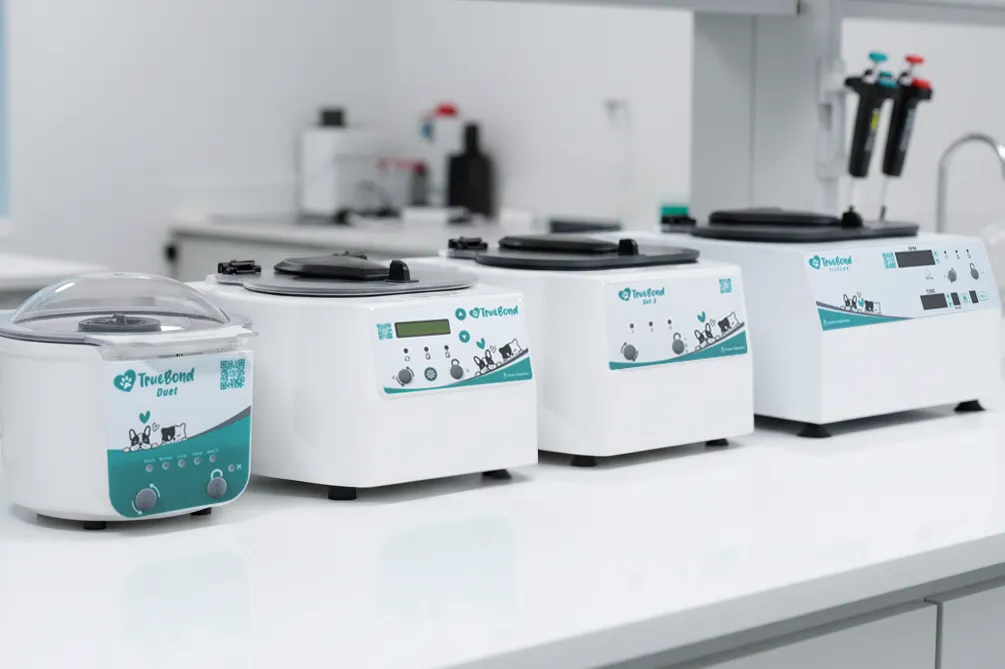
How to Choose the Right Centrifuge Capacity for Your Veterinary Practice
Published March 6, 2026Buying a centrifuge with too little capacity creates workflow bottlenecks. Buying too much capacity wastes money and counter space. The right choice comes from calculating your actual daily sample volume, not theoretical maximums.
TLDR:
- Calculate average daily samples from the past 3-6 months, not peak theoretical volume
- 4-6 tube capacity works for practices processing under 15 samples daily
- 12+ tube capacity suits high-volume clinics or practices offering PRP treatments
How many samples does your veterinary practice actually run per day?
Pull your reference lab records from the past six months. Count the samples you currently send out for chemistry panels, thyroid tests, and other serum-based work. This number—not your busiest day ever—determines your centrifuge capacity needs.
Most small animal practices process 8-15 diagnostic samples daily. High-volume practices or multi-doctor clinics may run 25-40 samples. Emergency and specialty hospitals can exceed 50+ samples during peak periods.
The mistake is buying for your busiest day instead of your average day. A practice that runs 12 samples daily but had one Saturday with 28 samples doesn’t need capacity for 28. They need capacity for 12-15, with the ability to run two batches on rare busy days.
What tube capacity should you look for in a veterinary centrifuge?
Match centrifuge capacity to your daily volume plus 20-30% buffer:
4-6 tube capacity: Practices processing under 15 samples daily, single-doctor clinics, mobile practices
8-12 tube capacity: Multi-doctor practices processing 15-30 samples daily, clinics adding PRP services
12+ tube capacity: High-volume clinics processing 30+ samples daily, practices running diagnostic and regenerative medicine simultaneously
The buffer matters because samples don’t arrive evenly throughout the day. You might process three samples mid-morning, then get five more during afternoon appointments. Insufficient capacity means waiting for the first batch to finish before starting the second.
Does tube size affect capacity calculations?
Yes. Centrifuge capacity is listed as tube count, but tube sizes vary. A “12-tube centrifuge” might hold twelve 13mm tubes or eight 16mm tubes plus four smaller tubes. Veterinary practices typically use:
- 13mm x 75mm tubes: Standard blood collection for larger animals, most common for routine diagnostics
- 13mm x 100mm tubes: Larger sample volumes when standard tubes don’t provide enough serum
- Microcollection tubes (BD Microtainer, Greiner Minicollect): Standard for small and exotic animals
- 16mm x 100mm tubes: Higher-volume samples for larger patients or when 13mm tubes provide insufficient volume
- PRP tubes (often 15-16mm diameter): Required for regenerative medicine protocols
- Urine and fecal sample tubes: Variable sizes depending on collection method and testing requirements
Check whether your centrifuge holds the tube sizes you actually use. Some models require rotor changes or adapter swaps to accommodate different tube sizes—adding complexity to your workflow. Ready-to-use centrifuges accept multiple tube sizes simultaneously without adapter changes.
How do you calculate processing time based on capacity?
Centrifugation takes 5-10 minutes per batch depending on protocol. If your 6-tube centrifuge is processing samples and three more patients arrive needing bloodwork, the second batch waits 5-10 minutes for the first to complete.
Calculate realistic throughput: A 6-tube centrifuge running 8-minute cycles can process approximately 45 samples during a 60-minute period if you’re continuously loading and unloading. But veterinary practices don’t run samples continuously—they come in clusters.
The practical question: Can you afford 10-15 minute delays during busy periods? Small practices often can. High-volume clinics or practices offering same-day surgery with preanesthetic bloodwork may need larger capacity to avoid bottlenecks.
Should you buy one large centrifuge or multiple smaller units?
One larger centrifuge works for most general practices. Two smaller centrifuges make sense when:
- You’re running both diagnostic samples and PRP/regenerative medicine (different protocols, different timing)
- You process microcollection tubes for small/exotic animals separately from standard blood tubes, urine, and fecal samples
- You have multiple lab areas (main hospital plus separate surgical suite)
- Your practice has extremely high volume with samples arriving constantly
- You need backup equipment to avoid workflow disruption during service/maintenance
Space and budget usually favor a single appropriately-sized unit. But practices with diverse patient populations (large animals plus small exotics) or those offering PRP treatments alongside high diagnostic volume often find that dedicated units prevent scheduling conflicts and accommodate different tube size requirements efficiently.
What happens if you choose too small a capacity?
You run multiple batches, which adds 5-10 minutes per extra batch. For a practice processing 18 samples with a 6-tube centrifuge, you’re running three batches instead of two. That’s an extra 8-10 minutes added to your workflow.
Multiply this across multiple days and multiple weeks. The time cost adds up. More significantly, it creates frustration for staff and delays results for doctors waiting to interpret bloodwork.
Insufficient capacity doesn’t break your workflow—it just makes it slower and more annoying than it needs to be.
What happens if you choose too large a capacity?
You waste money and counter space. A 24-tube centrifuge costs more than a 12-tube model and occupies more footprint. If you’re processing 12 samples daily, you’re paying for capacity you don’t use while sacrificing valuable counter space.
Veterinary practices face constant space constraints. Every piece of equipment competes for limited counter area. Right-sizing your centrifuge frees space for other essential equipment.
The exception: practices planning significant growth or adding services like PRP therapy should buy slightly ahead of current needs. But “slightly ahead” means 30-40% extra capacity, not double.
How does offering PRP therapy affect capacity needs?
PRP protocols typically require 12-15 minute processing times and use larger tubes than diagnostic samples. A practice running PRP preparations for orthopedic treatments needs either:
- Sufficient capacity to run PRP tubes alongside diagnostic samples, or
- A second dedicated centrifuge for regenerative medicine
Most practices starting PRP services choose a compact unit for PRP and use their existing centrifuge for diagnostic work. This prevents scheduling conflicts between 5-minute diagnostic spins and 12-minute PRP protocols.
Calculate PRP volume separately from diagnostic volume. A practice running 2-3 PRP treatments weekly plus 15 diagnostic samples daily has different needs than a practice running 15 diagnostic samples only.
What tube capacity do mobile veterinary practices need?
Mobile practices typically need 4-6 tube capacity—enough for routine wellness screening and sick patient diagnostics without excessive size or weight. Portability matters more than maximum capacity when you’re moving equipment between vehicles and homes.
The constraint is counter space at client locations, not clinic space. Compact centrifuges that process 4-6 tubes adequately serve mobile practice needs while fitting in limited space.
Does centrifuge speed affect capacity decisions?
No. Speed (measured in RPM or RCF) determines how well the centrifuge separates samples, not how many samples you can process. Most veterinary diagnostic samples require 3,000-4,000 RPM. PRP protocols may require different speeds depending on the specific protocol.
Variable speed centrifuges let you run different protocols, but this doesn’t change capacity needs. You still need enough tube positions for your daily sample volume.
The confusion happens when practices compare centrifuges and see different speed ranges. Focus on capacity first, then verify the speed range covers your protocols.
How do you plan for practice growth?
Review your sample volume trends over the past 12-24 months. If you’re consistently increasing 10-15% annually, buy 30-40% above current capacity. This gives you 2-3 years before outgrowing the equipment.
If your volume is stable, buy for current needs. You can always add a second centrifuge later if you add services or expand the practice.
The mistake is buying excessive capacity “just in case.” Equipment technology improves. Your practice needs may change. Buying a 24-tube centrifuge when you process 10 samples daily means paying for unused capacity that might never get used.
What capacity do emergency and specialty hospitals need?
Emergency hospitals and specialty practices often need 12+ tube capacity with the ability to run continuous batches. Sample volume in these settings can spike unpredictably—five samples one hour, twenty samples the next.
Multiple centrifuges often make more sense than a single large unit. This provides redundancy (critical when equipment failure disrupts patient care) and lets you run different protocols simultaneously.
High-volume settings benefit from ready-to-use centrifuges that eliminate rotor and adapter complexity. When multiple staff members across different shifts operate equipment, simplicity reduces errors and training time.
Should you consider expandable capacity systems?
Some centrifuges offer interchangeable rotors for different capacities and tube sizes. This sounds flexible but adds complexity. Staff must select the correct rotor, install it properly, and match appropriate adapters to tube sizes.
For some veterinary practices, this complexity can create opportunities for errors. A centrifuge that’s ready to use with multiple tube sizes accommodated simultaneously is simpler than systems requiring rotor changes.
The exception is research settings or specialized veterinary labs where trained lab personnel operate equipment consistently. General practice benefits more from simplicity than flexibility.
How do you verify you’ve chosen the right capacity?
After installation, track your usage for 30-60 days:
- How often do you run multiple batches?
- How often is the centrifuge at full capacity?
- Are you experiencing workflow delays during busy periods?
If you’re consistently running at 80-100% capacity with frequent multi-batch processing, you chose too small. If you’re rarely filling more than 40-50% of capacity, you bought larger than necessary.
This data also helps if you’re considering a second location or planning equipment purchases for practice expansion.
Need help determining the right centrifuge capacity for your practice? Drucker Diagnostics offers veterinary centrifuges from compact 6-tube models to high-capacity systems—all with ready-to-use simplicity. [View capacity options →]