
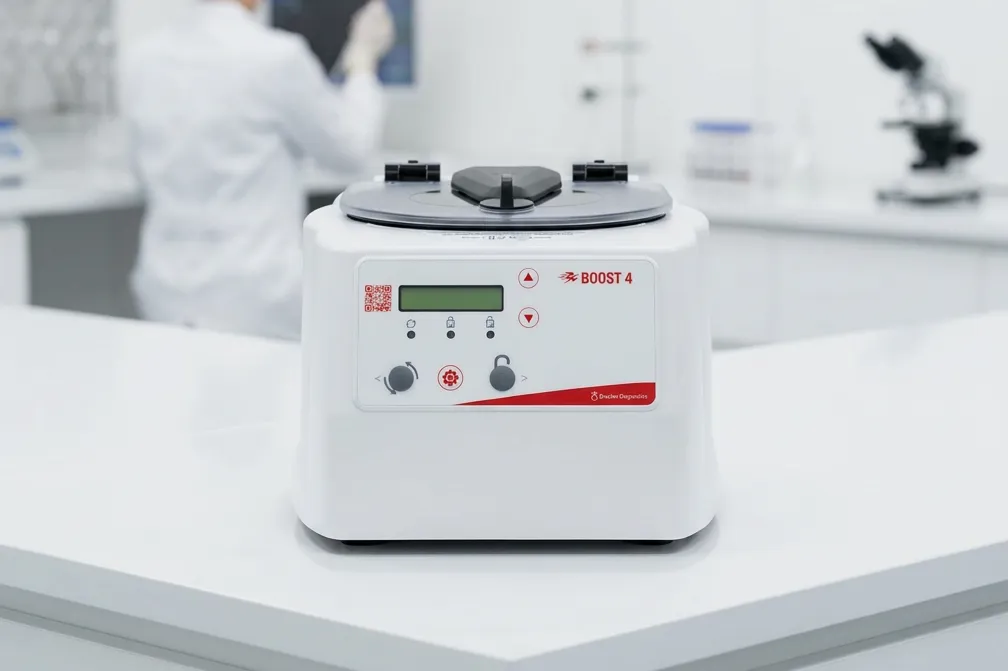
How to Choose a Centrifuge for Regenerative Medicine
Published March 10, 2026Regenerative medicine has moved from specialty clinics to mainstream practice. Orthopedic surgeons, sports medicine physicians, dermatologists, pain management specialists, and family practice physicians now routinely offer treatments that depend on centrifuge-based blood separation. The treatment outcomes their patients experience start with one decision: which centrifuge is in the procedure room.
This guide covers the technical criteria that matter most when evaluating a centrifuge for regenerative medicine applications—without the marketing noise.
TLDR Summary:
- The centrifuge you choose directly affects preparation quality—RCF precision matters more than maximum RPM.
- Tube and rotor compatibility should be confirmed before purchase, not assumed. Not all centrifuges work with every kit.
- A ready-to-use centrifuge with validated rotor-tube pairings eliminates the most common source of inconsistent results.
Why a “Lab Centrifuge” Isn’t Automatically the Right Centrifuge
Many practices start with a general-purpose laboratory centrifuge, assuming any unit that spins blood will work. That assumption leads to inconsistent preparations.
The issue is specificity. A research centrifuge rated at 15,000 RPM is engineered to pellet cells, proteins, or DNA. Regenerative medicine applications require something fundamentally different: controlled, low-to-moderate speed separation that isolates specific blood components without damaging them in the process.
The Five Specs That Actually Matter
1. RCF Precision, Not Just RPM
Revolutions per minute (RPM) is the number your centrifuge displays. Relative centrifugal force (RCF) is the number that determines separation quality.
Here’s why the distinction matters: two centrifuges spinning at identical RPMs will generate different RCF values if their rotors have different diameters. A 3,500 RPM spin in a large-diameter rotor produces significantly more force than 3,500 RPM in a compact rotor. Without knowing the actual RCF, you can’t standardize protocols or troubleshoot inconsistent results.
Look for centrifuges that let you input RCF directly—not just RPM—and maintain that target force within a tight tolerance regardless of load variations.
Q: What’s the difference between RPM and RCF, and which one matters more?
A: RPM measures rotor speed. RCF measures the actual force applied to the sample. RCF is the clinically relevant metric because it determines how effectively blood components separate. Two centrifuges at the same RPM can produce very different RCF values depending on rotor geometry.
2. Rotor Design and Angle
Swinging-bucket (horizontal) rotors are the standard for clinical blood separation. The rotor design affects how cleanly layers form and how much cross-contamination occurs between components.
Horizontal rotors produce the cleanest layers with minimal cross-contamination between blood components. They also introduce less shear stress during acceleration and deceleration, which helps preserve sample quality in sensitive applications.
For regenerative applications, rotor angle preferences are mixed—some practitioners prefer fixed-angle rotors in the 25°–35° range, some prefer horizontal rotors, and others find both work equally well for their protocols.
The rotor should also be easy to clean, autoclavable, and designed to accept the specific tube sizes your protocols require without adapters when possible.
3. Tube Compatibility
This is where most purchasing mistakes happen.
A centrifuge validated for 10 mL vacuum-sealed tubes may not perform the same way with 8 mL kits from a different manufacturer. Differences in tube wall thickness, conical geometry, and anticoagulant volume all affect where the separation layers form.
Many PRP kit manufacturers provide their own tubes along with centrifuge specifications for optimal separation. Before purchasing a centrifuge, confirm that the manufacturer provides validated tube compatibility for the specific tube types and kits you plan to use. If the answer is “it should work with most standard tubes,” that’s not validation—that’s a guess.
Q: Do all centrifuges work with all blood collection tubes?
A: No. Tube diameter, length, material, and internal geometry vary between manufacturers and kit types. A centrifuge that isn’t validated for your specific tubes can produce poor separations even when RPM and time settings are correct. Always verify tube compatibility before purchasing.
4. Programmable Protocols
Manual settings introduce variability. Every time a staff member dials in RPM and time by hand, there’s a chance for error—especially in high-volume practices.
A centrifuge with programmable, saved protocols ensures that every preparation follows the same parameters. Some centrifuges go further with features like automatic acceleration and deceleration ramp control, which prevents turbulent mixing of already-separated layers during spindown.
5. Safety Features and Certifications
A clinical centrifuge is a high-speed mechanical device operating inches from your staff and patients. Non-negotiable safety features include automatic lid locking during operation, imbalance detection with automatic shutoff, and aerosol containment.
On the certification side, look for FDA registration, ISO 13485 compliance, and CE marking. These aren’t just checkboxes—they represent validated manufacturing processes, documented quality systems, and traceable calibration records.
Ready-to-Use vs. Build-Your-Own: The Hidden Cost of Complexity
The centrifuge market splits into two approaches.
Option A: Component-based systems. You select a centrifuge body, then choose rotors, adapters, tube inserts, and buckets separately. This approach offers maximum flexibility—and maximum opportunity for error. Wrong adapter? Poor separation. Incompatible rotor? Voided warranty. Missing insert? Damaged tubes.
Option B: Ready-to-use centrifuges validated for use. The centrifuge ships with matched rotors and validated tube configurations. You open the box, plug it in, and run your first protocol. No compatibility research. No adapter hunting. No surprises.
For regenerative medicine practices—where the centrifuge is a clinical tool, not a research instrument—Option B eliminates the most common failure point: human error in system configuration.
Q: What does “ready-to-use” mean for a clinical centrifuge?
A: A ready-to-use centrifuge ships with pre-matched rotors and tube holders that are validated for specific applications. There’s no separate rotor selection, no adapter compatibility research, and no risk of ordering the wrong components. It’s designed to work out of the box for clinical workflows.
Benchtop vs. Floor-Standing: Match the Machine to the Practice
Most regenerative medicine practices need a benchtop centrifuge. Here’s why.
Floor-standing centrifuges are designed for high-volume laboratory environments processing hundreds of samples daily. They offer larger capacities and higher maximum speeds—neither of which is relevant for a practice running 5–20 regenerative procedures per day.
A compact benchtop unit fits on a countertop or cart in the procedure room, keeps the preparation close to the point of care, and reduces the time between centrifugation and application—which matters for sample quality.
Q: What size centrifuge do I need for a regenerative medicine practice?
A: Most practices processing 5–20 preparations per day are well-served by a benchtop clinical centrifuge. These units offer the speed range, capacity, and RCF control needed for regenerative applications without the footprint or cost of a floor-standing model.
What to Ask the Manufacturer Before You Buy
Use these questions to separate serious clinical centrifuge manufacturers from companies repurposing lab equipment for medical applications:
On kit compatibility: “Is your centrifuge validated for use with the specific PRP kits I plan to use?” (Note: Separation performance data comes from the kit provider, but the centrifuge manufacturer should confirm tube compatibility.)
On RCF: “Does your centrifuge allow direct RCF input, or only RPM? What’s the RCF tolerance?”
On tube holders: “What tube sizes and types does your rotor accommodate? Do I need separate adapters or inserts for different kits?”
On service: “What’s the average repair turnaround time, and do you have certified technicians in my region?”
On compliance: “Is this device FDA-registered for clinical blood separation? Can you provide calibration certificates and ISO documentation?”
On protocols: “Can I save and lock custom protocols so staff can’t accidentally change settings?”
If any of these questions get vague answers, keep looking.
The Bottom Line
The right centrifuge for regenerative medicine isn’t the fastest, the biggest, or the most expensive. It’s the one that delivers consistent, validated separation with the specific tubes and protocols your practice uses—every time, with minimal staff training and zero guesswork.
Prioritize RCF precision over RPM hype. Confirm tube-specific validation before you buy. Choose a centrifuge that eliminates compatibility complexity rather than adding to it. And treat safety certifications as requirements, not nice-to-haves. Your preparations are only as reliable as the equipment behind them.
Drucker Diagnostics manufactures ready-to-use centrifuge systems for clinical, veterinary, and regenerative medicine applications. Explore our full centrifuge lineup at druckerdiagnostics.com/products.